LDD-11 · Exterior Envelope (IMP)
One-line intent
A robust, forgiving, high-performance environmental shell using insulated metal panels (IMP), with selective interior framed assemblies for acoustic + human warmth in habitable zones.Design intent · AI render
FPO · AI render
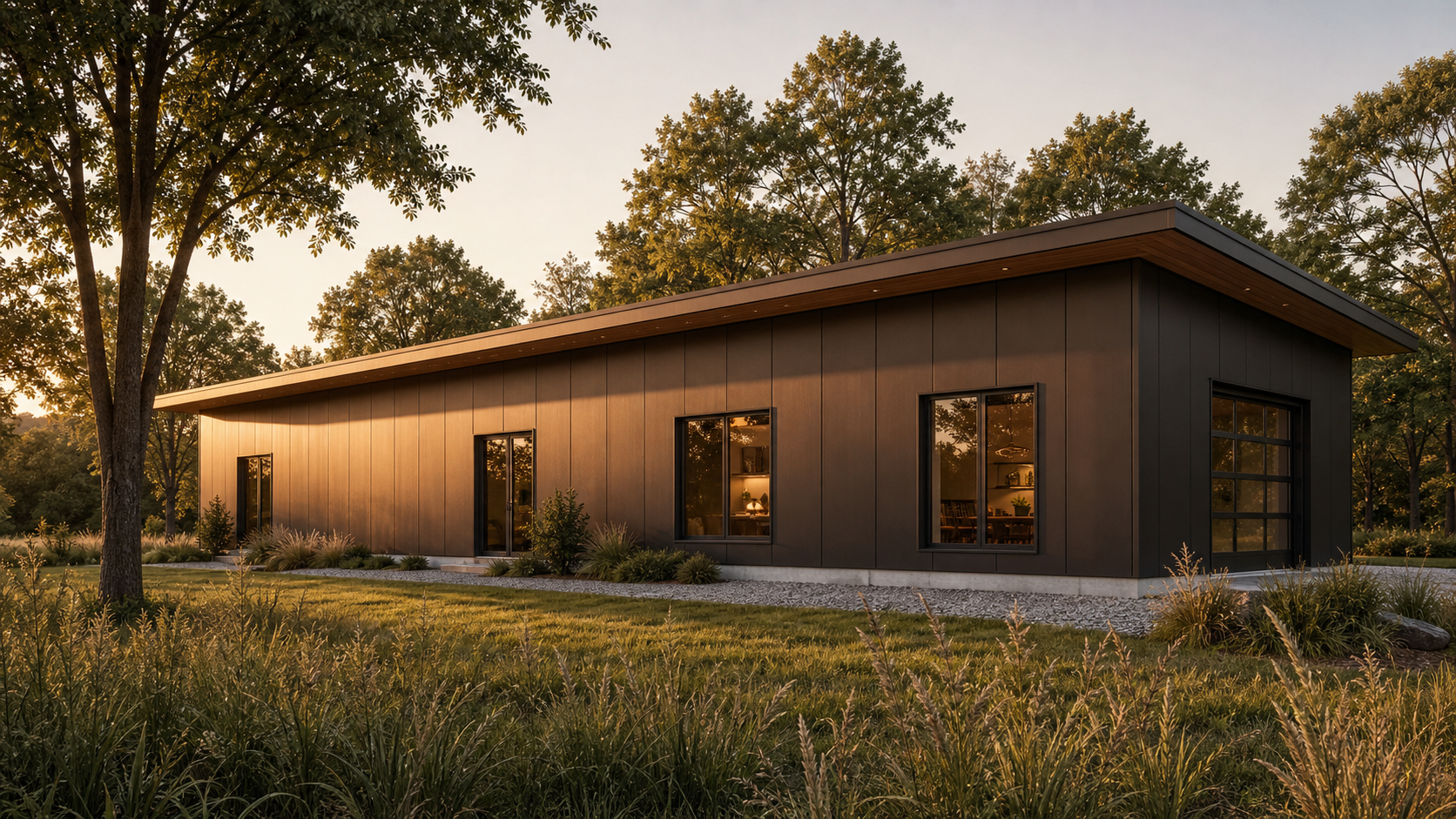
Architectural intent render of LDD-11's matte dark brown IMP envelope + 4' perimeter overhang in the Delaware landscape. For Position Only: AI-generated from the prompt below. Click to enlarge.
Locked decisions
Primary wall (outside → inside)
- Factory-finished exterior metal skin (matte dark)
- Continuous rigid foam insulation core
- Factory-finished interior metal liner
Secondary interior wall (in habitable zones)
- Optional service cavity
- Independent wood stud framing
- Mineral wool acoustic insulation (LOCKED)
- Drywall and/or selective wood finish
Material strategy
- Exterior: matte dark brown — Kynar 500 PVDF finish (LOCKED, per builder)
- Color logic: dark brown integrates with Delaware mid-Atlantic landscape (deciduous canopy + native grasses + stream-adjacent context) more naturally than gray-black would
- Interior: hybrid by zone — exposed IMP in infrastructural zones, layered drywall + mineral wool in living-oriented
Open items / engineer review
- IMP panel thickness — 4", 5", or 6" (R-26 to R-42)
Panel finish tier— Resolved: Kynar 500 PVDF, dark brown (per builder, 2026-05-15)- Vapor strategy — IMP is vapor-tight both sides; need air control layer detail at joints/penetrations
- Air sealing detail at IMP-to-IMP, IMP-to-foundation, IMP-to-roof, IMP-to-glazing
- Slab-edge insulation continuity at IMP-to-slab
- Lightning protection for large metal building
- Airtightness target (ACH50) — currently unspecified
Cost drivers (corrected 2026-05-15 PM — arithmetic error)
IMP wall area: ~7,000–8,000 sqft (perimeter 360' × ~22' avg height = 7,920 sqft, net of openings ≈ 7,070 sqft). NOT 13,500 sqft as previously stated — the earlier 13,500 figure was an arithmetic error (`360 × 22` ≠ 14,400). IMP wall installed at $17/sqft avg = ~$120–135K (was $230K). IMP roof $85–145K (LDD-01). Interior framing + mineral wool + drywall ~3,000 sqft = $66–105K.4' perimeter overhang (added per builder)
The design includes a 4-foot perimeter overhang wrapping the building. Functions: rain-shedding well away from wall-roof joints; summer solar shading on south face (critical for Delaware sun angles); year-round usable shade band; coordinates with monopitch to keep eaves consistent west-to-east. Significant feature missed in earlier drafts.Air-gap concerns
- Condensation risk on interior IMP liner — both sides vapor-tight. Hybrid mitigates in habitable zones; verify utility zone exposure.
- Thermal bridging at fasteners + clips — verify effective R, not nominal.
- Roof IMP at ½"/ft is below most manufacturers' preferred minimum for cold climate.
- Acoustic underperformance for gym west IMP wall (low-frequency basketball impact).
- Lightning + grounding — large metal shell needs bonding strategy.
- Finish tier matters long-term. Kynar 500 holds color 25–35 years vs SMP 8–15 years. $1–3/sqft × 13,500 = $13–40K premium worth considering.
- No airtightness target — without it, you don't know what you got. ≤1.5 ACH50 reasonable; ≤0.6 ACH50 is Passive House level.
Builder's question (Peter, 2026-05-15 PM, via David) — IMP vs alternatives?
"Can you ask Claude if he agrees with the use of IMPs as a clean and cost-efficient solution for the building envelope vs other solutions?"
Yes — IMP is the right envelope for this PEMB residential build.
| Alternative | vs. IMP | Verdict for this build |
|---|---|---|
| Site-built layered wall (cladding + WRB + sheathing + insulation + framing + drywall) | Cheaper materially; much more labor (5+ trades vs 1); thermal bridging at every stud; dozens of joint failure points | IMP wins on labor + air/vapor control |
| SIPs (Structural Insulated Panels) | OSB facings; doesn't pair structurally with PEMB | Wrong tool for PEMB |
| ICF (Insulated Concrete Forms) | Great thermal mass + soundproofing; doesn't integrate with PEMB cleanly | Wrong tool for PEMB |
| Stud wall + closed-cell spray foam | Comparable R-value; more VOCs; fire considerations at thickness; harder to demo/modify | IMP wins on factory QC + recyclability |
| Agricultural barn enclosure (R-Tac, vinyl-faced fiberglass) | Cheapest PEMB enclosure | Poor envelope performance; not residential-appropriate |
| IMP (Kynar 500 dark brown — spec'd) | Continuous insulation, factory air/vapor control, single-trade install, integrated finish, 25–35 year color stability | Right call |
Where IMP loses: future modifications. Cutting in a new window after the fact is harder than stick-built. For a build-once-and-live-with-it project, IMP wins.
The 4' perimeter overhang makes IMP even better — sheds rain away from joints (the IMP failure mode if poorly detailed), shades the south face in summer, gives the building a "hat" that conventional wall systems can't easily replicate.
Cost positioning: IMP at corrected $130K wall is mid-range — more than agricultural-barn (~$70–90K, performs poorly), less than stick-built layered wall (~$160–200K all-in), comparable to SIPs/ICF. Premium over agricultural is justified by 50-year performance + maintenance reduction.
Cross-references
→ Outputs to
LDD-18 habitable zone wall finishDiagram
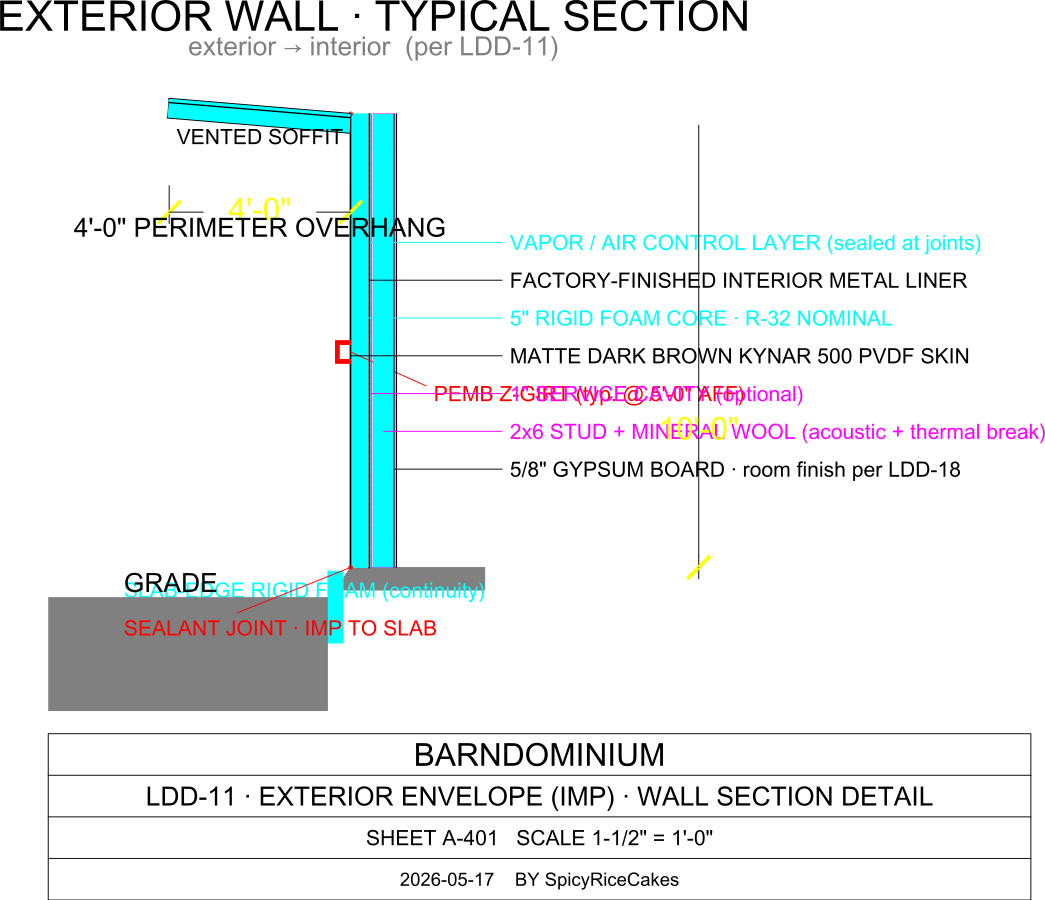
IMP envelope perimeter + 4' overhang projection + glazing openings + slab-edge detail. Generated plan diagram from the SpicyRiceCakes architecture toolchain. Click to enlarge.