The ceiling is a designed system, not exposed chaos.
Design intent · AI render
FPO · AI render
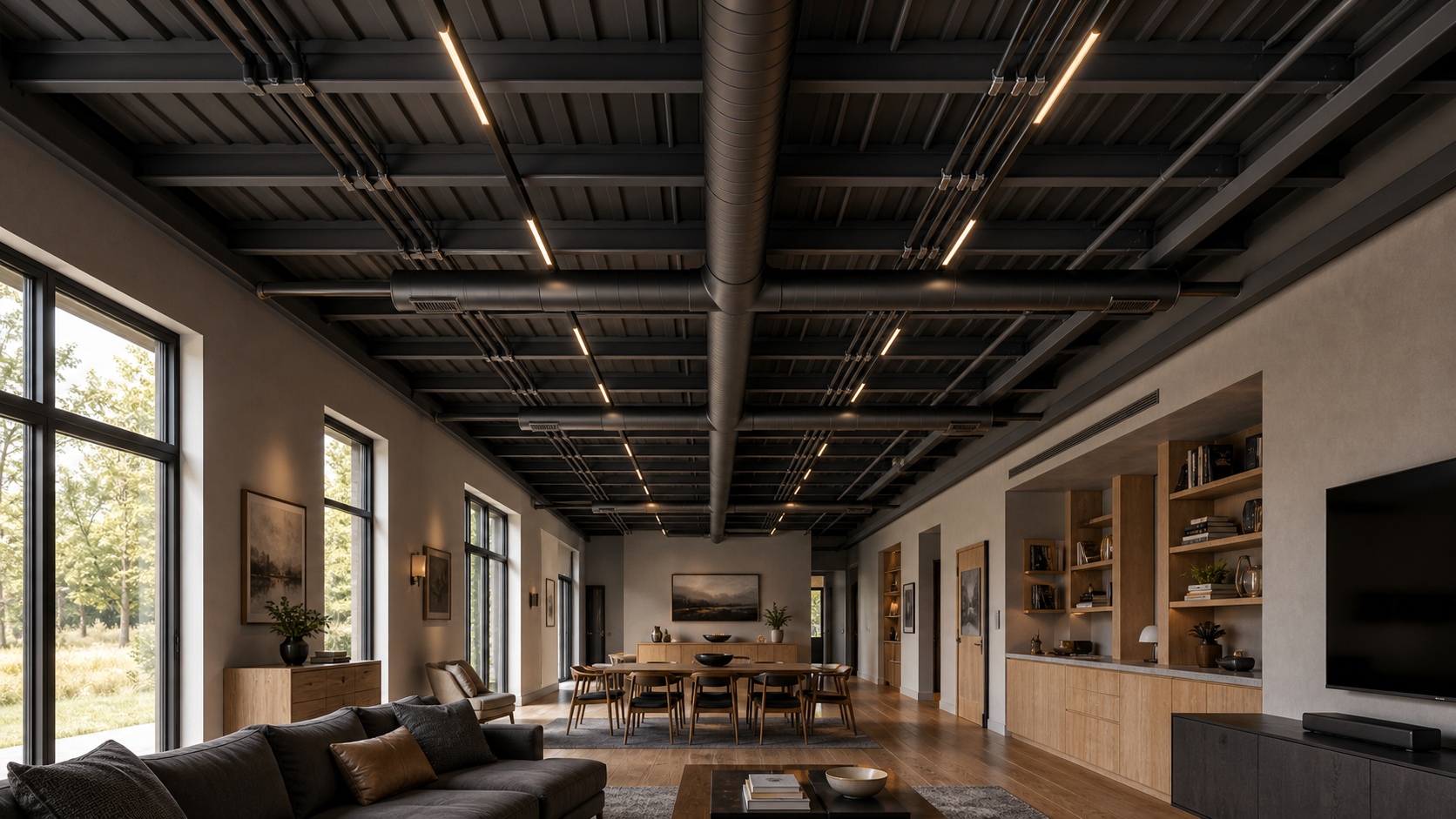
Architectural intent render of LDD-12's five-layer ceiling hierarchy — straight, aligned, intentional. For Position Only: AI-generated from the prompt below. Click to enlarge.
Codex prompt & how to regenerate
To regenerate: hand the prompt below to Codex / ChatGPT with image generation enabled (or any gpt-image-1 / DALL-E 3 endpoint), save the result as site/diagrams/12-ceilings-fpo.png, redeploy. Page picks it up automatically.
Recommended params: model gpt-image-1, aspect 16:9, size 1536 × 1024.
Prompt:
Architectural interior rendering of a luxury barndominium living-wing zone, looking up and forward to emphasize the exposed ceiling system. Wide-angle photoreal view of a long living/dining volume with the full LDD-12 five-layer ceiling hierarchy visible simultaneously — structure, HVAC trunk, branch ducts, electrical conduit, lighting — all aligned, parallel, intentional. 16:9 aspect. No people in frame. Neutral midday or early-afternoon daylight from west glazing so the ceiling discipline is clearly readable.

Spatial framing. Slightly elevated camera (~5'-9" eye-level) at ~24mm full-frame equivalent, looking lengthwise through a long living-wing volume so the ceiling occupies the upper two-thirds of the frame and the floor/wall plane occupies the lower third. The room is calm, restrained, residential — but the ceiling above is the visual protagonist. The viewer should immediately read the five-layer hierarchy.

Ceiling hierarchy (focal feature — all five layers visible).
1. Structure (layer 1). Exposed PEMB primary frames and secondary purlins in dark charcoal, running N-S and E-W in a clean orthogonal grid. The structural geometry is the foundation — every other layer defers to it.
2. Main HVAC trunk (layer 2). A single large round duct (16"-20" diameter, matte dark finish) runs in one long straight line, parallel to the structural bay direction, suspended on tidy steel hangers from the purlins. No diagonal. No elbow except at turns aligned 90 degrees to structure.
3. Branch ducts (layer 3). Smaller round branch ducts (8"-10") tee off the main trunk at 90 degrees only, running to ceiling registers in adjacent zones. Parallel runs. Long-radius turns. No flex duct visible.
4. Electrical conduit (layer 4). Two or three parallel bundled EMT conduit runs (dark powder-coat finish) routed alongside the trunk, then turning 90 degrees to make vertical drops to wall outlets and switches. No crossings. No diagonals.
5. Lighting (layer 5). Linear LED fixture runs (slim, dark-bronze housing) mounted tight to the secondary structure, aligned N-S to match the bay rhythm. Continuous warm 2700K wash. No suspended fragile fixtures dropping below the cloud plane.

The rule "straight, aligned, intentional · only N-S or E-W · only 90 degree intersections · no diagonals · no zig-zags" should be visually self-evident.

Lower volume. The living-wing zone below the ceiling is calm and restrained — medium warm-gray wall fields, soft charcoal seating, warm white-oak floor, restrained dark-bronze metal trim, one or two large windows on the west wall with warm afternoon sunlight pouring in. The room is dressed, not empty (a sofa, a low coffee table, a console), but reads as quiet so the eye returns to the ceiling.

Material palette (ceiling). Dark charcoal exposed PEMB, matte dark HVAC ducts, dark powder-coat electrical conduit, dark-bronze linear LED housings, no chrome, no exposed insulation, no acoustic-tile ceiling. Material palette (room). Medium warm-gray walls, soft charcoal upholstery and rug, warm white-oak floor, dark-bronze accents.

Lighting mood. Neutral early-afternoon daylight from the west glazing washing the floor and lower wall. Linear LED ceiling fixtures at dimmed atmospheric setting providing layered warm fill. The exposed ceiling reads dim relative to the daylight, but its geometry is sharply legible.

What this is NOT (critical). Do NOT render as: an industrial loft with theatrically exposed wiring, a steampunk warehouse, a commercial drop-tile ceiling, a residential drywall ceiling with can lights, a gymnasium ceiling, a warehouse, or a factory. NO flex duct. NO Romex/NM cable visible. NO diagonal runs. NO zig-zags. NO crossing conduits. NO acoustic tile grid. NO can lights. NO track lights. NO bare bulbs. NO bright primary colors. NO institutional finishes. NO suspended fragile pendants.

Style direction. Professional architectural visualization, photoreal, evenly exposed. The render's job is to make exposed mechanical/electrical infrastructure look architecturally calm and intentional — like a designed system, not exposed chaos. Sharp focus throughout, no shallow depth-of-field. Should feel like the ceiling cover image of an architecture monograph documenting "exposed but disciplined" residential infrastructure.
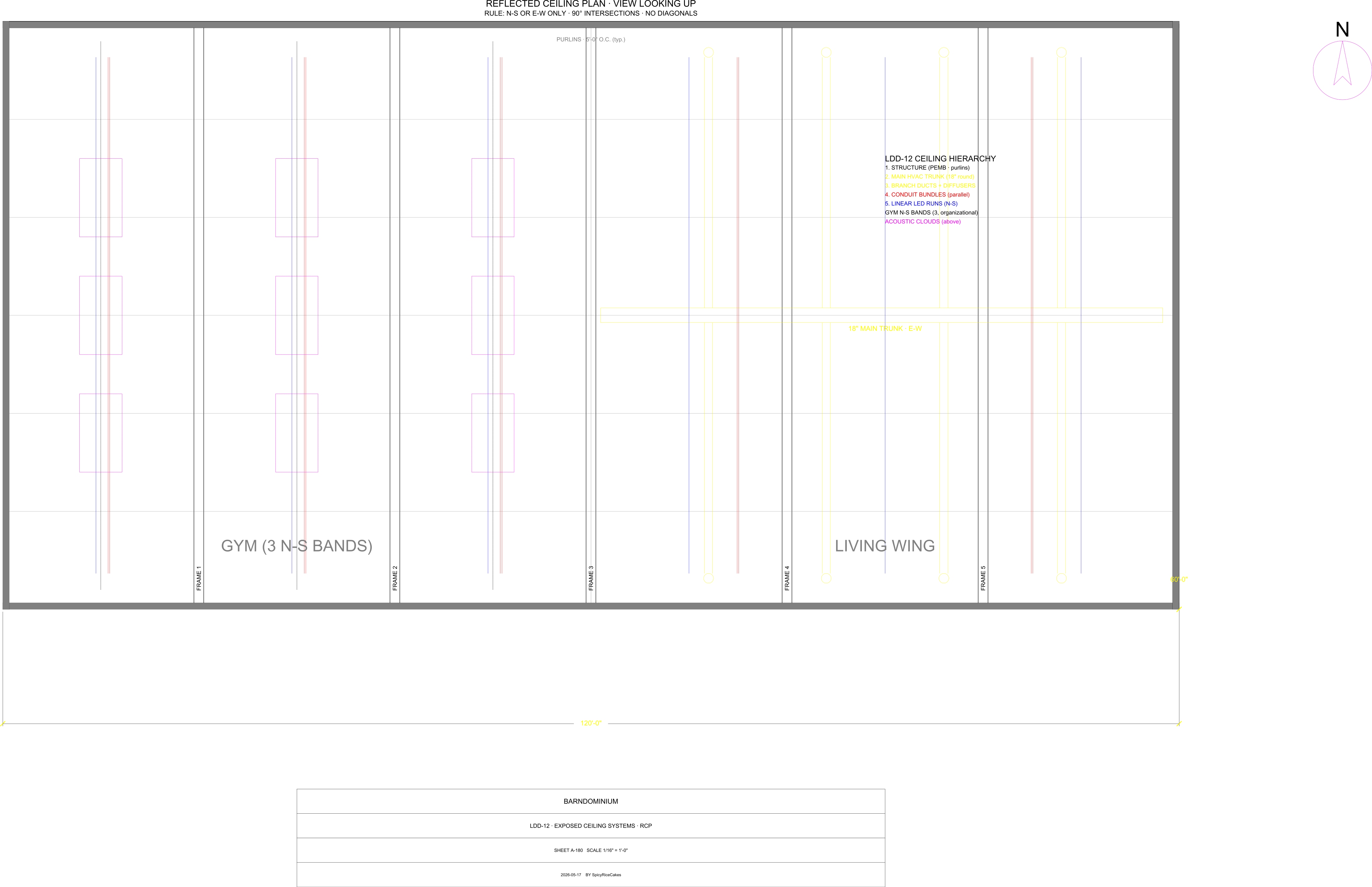
Hierarchy (highest priority placed first)
Structure (PEMB frames, purlins, spine beam)
Main HVAC trunk
Branch ducts
Electrical conduit
Lighting
Routing rules
Only N–S or E–W
Only 90° intersections
No diagonal runs · No zig-zags
Round ducts only · Long straight runs · Aligned to structure