The building glows, not shines — and zero-demolition maintenance forever.
Design intent · AI render
FPO · AI render
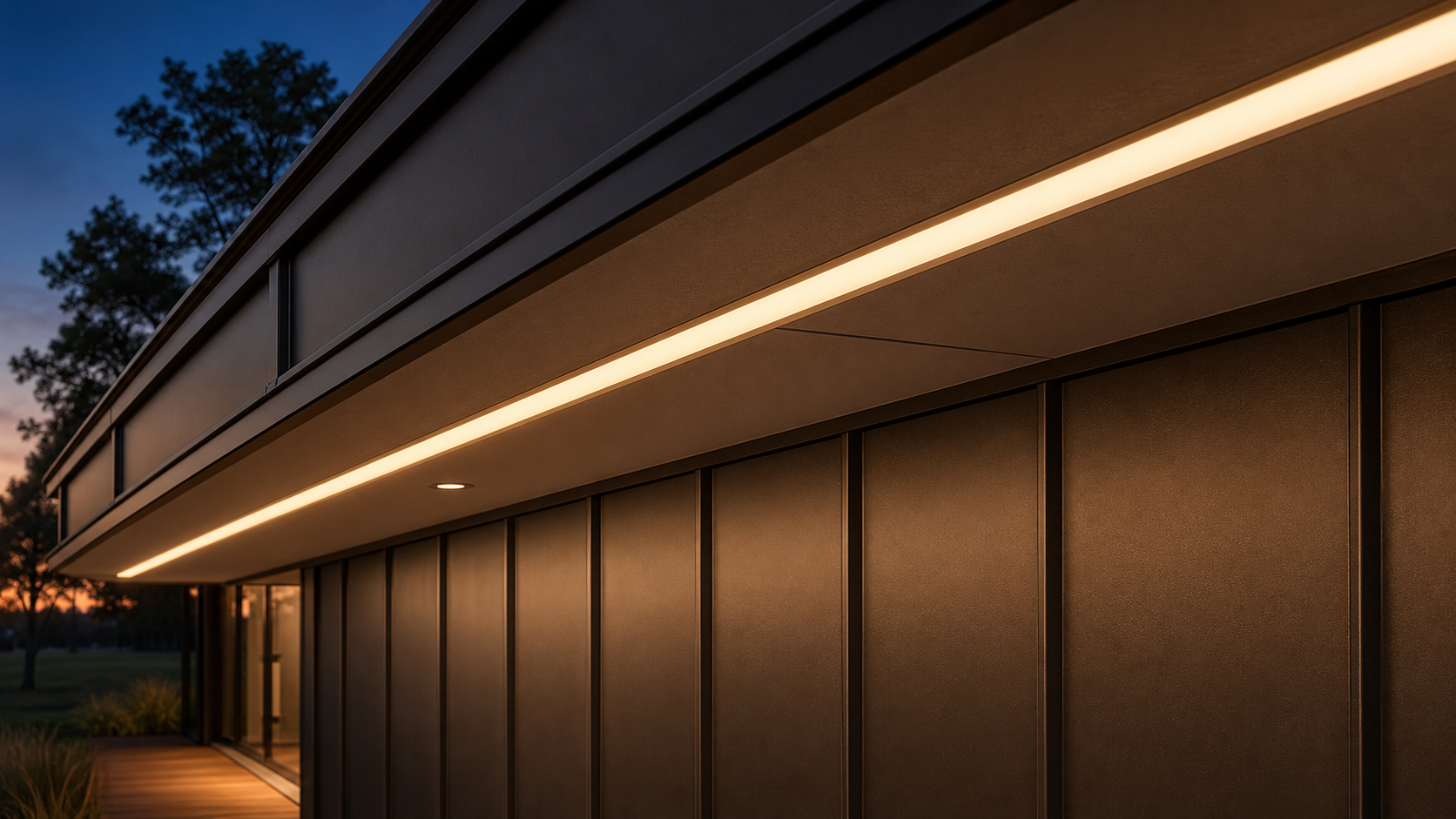
Architectural detail render of the eave soffit — concealed linear LED at 2700K, the building glows not shines. For Position Only: AI-generated from the prompt below. Click to enlarge.
Codex prompt & how to regenerate
To regenerate: hand the prompt below to Codex / ChatGPT with image generation enabled (or any gpt-image-1 / DALL-E 3 endpoint), save the result as site/diagrams/17-soffit-fpo.png, redeploy. Page picks it up automatically.
Recommended params: model gpt-image-1, aspect 16:9, size 1536 × 1024.
Prompt:
Architectural close-up detail rendering of the barndominium's eave soffit — looking up at the underside of the eave from just below, with the soffit's concealed linear LED wash dominating the frame. Photoreal still, 16:9 aspect, captured at the transition from golden-hour to early dusk. No people in frame.

Spatial framing. Tight close-up: roughly a 12' run of eave soffit fills the frame horizontally, with the camera positioned about 7' below the soffit and ~4' out from the building wall, looking up at an angle of ~30° from horizontal. The viewer sees the full soffit cross-section: standing-seam dark-bronze fascia at top, then the soffit panel plane, then the dark-bronze IMP exterior wall plane dropping below. The implicit reading: an inhabitant standing beneath the eave on the entry walk, noticing how the light works.

The soffit detail (the point of the render).
- A continuous slim aluminum channel is recessed flush into the soffit panel — a thin clean reveal line ~3/4" wide running the full length of frame. Inside the channel sits a frosted opal diffuser lens that reads as a single smooth luminous bar at 2700K. NO visible LED dots. NO hotspots. NO seams between segments (segmentation is functional, visually continuous).
- The light from the channel washes the adjacent IMP wall plane below, picking up the subtle vertical seam rhythm of the panels. The wash is smooth, even, and falls off gracefully as it descends — a true architectural glow, not a strip-light effect.
- The soffit panel itself is matte medium-warm-gray, picking up a faint indirect glow from the diffuser.
- A small secondary recessed downlight (~3" aperture, dark-bronze trim, very low glare) is visible centered in the soffit panel further down the run, casting a quiet warm pool on the ipe-board walk visible at the bottom of the frame.

Serviceability hint. At the far right of the frame, the diffuser shows a faint joint line indicating it's a bottom-access snap-on/snap-off lens — the maintenance story made visible without being labeled. NO visible screws. NO visible LED tape. NO visible driver housing (the driver lives indoors).

Ground plane (bottom of frame). A sliver of ipe-board entry walk in deep warm brown receives the downlight pool. The walk reads as quiet and well-detailed.

Sky/background (top edge of frame). Just enough of a deep blue-hour sky is visible beyond the eave drip edge to read as "the building's edge, glowing." The sky is dim enough that the soffit glow reads dominantly.

Lighting mood. The soffit is the dominant source in the frame. The mood is intimate, precise, almost reverent — this is the detail that makes the whole building work. Warm 2700K throughout. NO color shifts, NO RGB, NO theatrical effects.

Material palette. Dark-bronze standing-seam fascia and IMP panels, matte medium-warm-gray soffit panel, slim aluminum channel (matte dark to disappear), frosted-opal diffuser lens (the only bright element), warm white-oak hints (suggested ipe walk in deep warm brown), warm dimmable 2700K LED.

What this is NOT (CRITICAL). Do NOT render as: a fixture-catalog product shot, a landscape-lighting brochure, a recessed-can lighting display, a strip-light tutorial photo, an architectural-rendering "before" wide shot, or a generic building elevation. NO visible LED dots or chips. NO color-changing RGB. NO theatrical cove-light aesthetics. NO bare lamp visible. NO exposed wires. NO visible drivers. NO surface-mounted strips. NO fluorescent or cool-blue color temperature. NO hotspots or banding.

Style direction. Professional architectural visualization, photoreal, close-up macro-architectural detail. Calm and quiet mood. Slightly looking-up camera angle to celebrate the eave's underside. Sharp focus on the diffuser and soffit detail, with slight natural focus falloff at frame edges. The render should feel like a single page of a high-end architecture detail monograph, not a fixture catalog.
Locked decisions
Concealed linear LEDs · full perimeter coverage
Secondary minimal downlights as needed
Soft wash · no hotspots · default warm white
RGB only for events (not default)
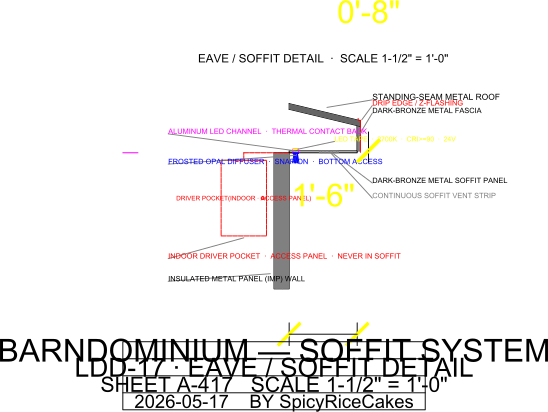
Aluminum channel system · bottom-access snap-on diffusers
16'–24' channel segmentation (failed segment doesn't strand long run)
Drivers always indoors — never in soffit, never exterior-exposed
Open items / engineer review
Driver pocket location strategy (hinged access panels in interior walls)
LED tape spec: 24V, CRI ≥ 90, density 60/120/240 LEDs/m