LOCKED v1.0 framework correct

LDD-08 · Lighting Framework

One-line intent

Light the space, not the fixture.

Design intent · AI render

FPO · AI render AI-rendered architectural visualization of a luxury barndominium living zone at evening — layered indirect lighting with no visible sources, cove glow at the wall/ceiling junction, wall-aperture slot perforations, under-shelf task lighting at a kitchen counter, two restrained dark-bronze table lamps, and a low floor-grazing glow at the wall/floor transition along a hallway
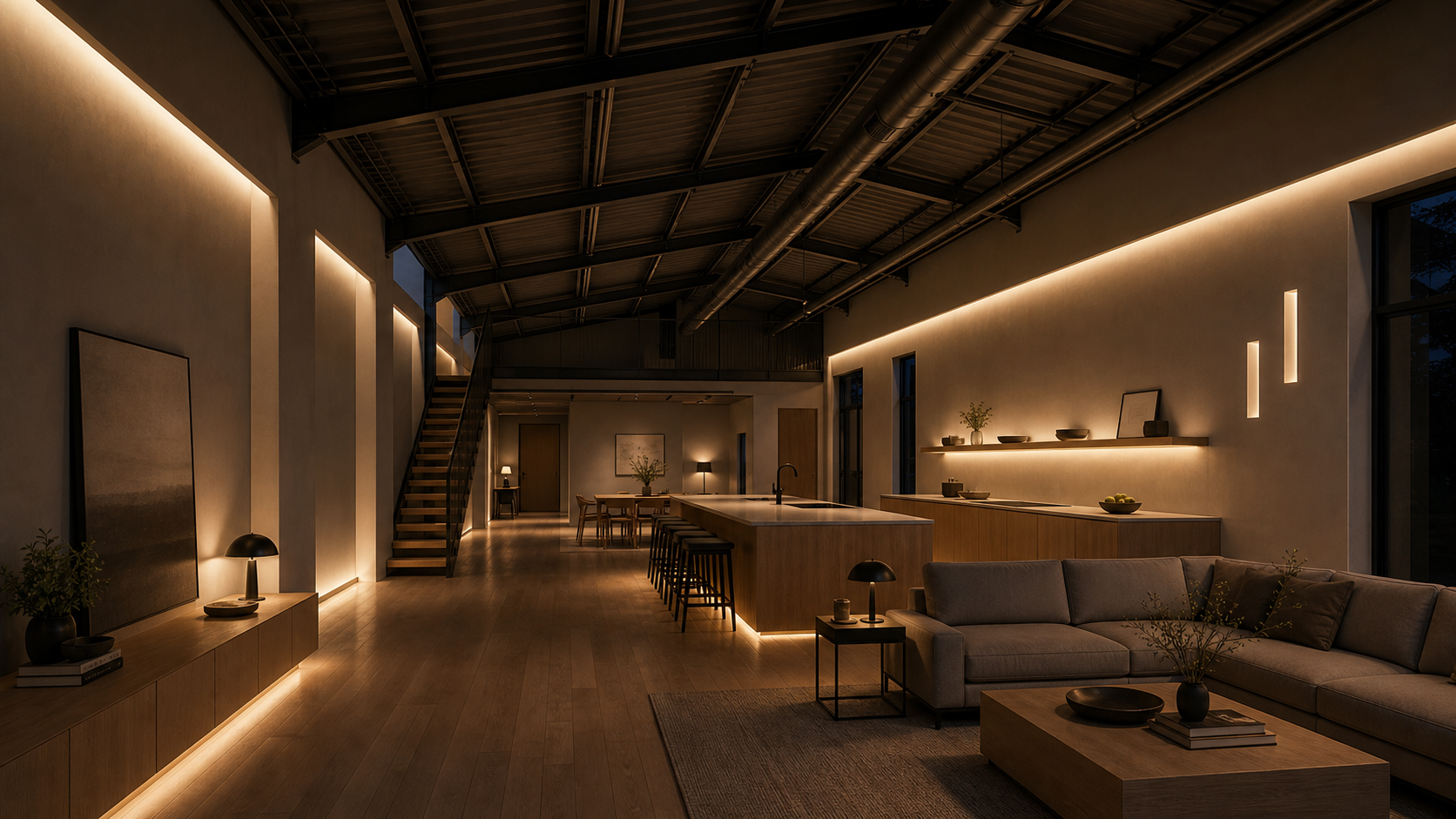
Architectural intent render of LDD-08's five-layer indirect lighting framework — light the space, not the fixture. For Position Only: AI-generated from the prompt below. Click to enlarge.
Codex prompt & how to regenerate

To regenerate: hand the prompt below to Codex / ChatGPT with image generation enabled (or any gpt-image-1 / DALL-E 3 endpoint), save the result as site/diagrams/08-lighting-fpo.png, redeploy. Page picks it up automatically.

Recommended params: model gpt-image-1, aspect 16:9, size 1536 × 1024.

Prompt:

Architectural interior rendering of a luxury barndominium living zone at evening, illustrating LDD-08's layered indirect lighting framework — "light the space, not the fixture." Wide-angle photoreal view of a long open living/dining/kitchen volume with exposed PEMB structure overhead and IMP perimeter walls. 16:9 aspect. No people in frame. Captured at "Evening" scene setting (dimmed, warm 2700K throughout).

Spatial framing. Eye-level perspective (~5'-6" camera height) at ~24mm full-frame equivalent, looking lengthwise through the open living/kitchen area so the viewer can see ceiling, wall, and floor planes simultaneously. The room reads as a calm horizontal volume divided by an implicit 16' AFF datum — grounded warm tactile surfaces below, exposed dark charcoal infrastructure above.

The five lighting layers, all visible simultaneously but each restrained.
1. Ambient (indirect ceiling/wall wash). Soft luminous gradients on upper walls and the underside of exposed PEMB structure, with no visible fixture — the source is concealed behind continuous cove channels at the wall/ceiling junction.
2. Wall apertures (type A/B/C). Two or three architectural slot perforations cut into a medium warm-gray wall plane, each glowing softly from a concealed source behind the wall — read as luminous architecture, not as light fixtures.
3. Task lighting. A long warm white linear glow under a continuous warm white-oak floating shelf above a kitchen counter / work surface, plus a discreet linear glow beneath the kitchen island overhang grazing the floor.
4. Human-scale (lamps). Two or three low-profile table or floor lamps in restrained matte-black or dark-bronze finish on side tables and a console — small warm pools at sitting height. Lamps must look like considered objects, not generic showroom fixtures.
5. Low-level navigation. A continuous faint warm glow at the wall/floor transition along a hallway and at the base of a stair tread, grazing the polished light-warm hardwood floor — concealed source, never a visible LED strip.

Material palette. Medium warm-gray wall fields, soft charcoal upper infrastructure, dark charcoal exposed PEMB purlins and secondary framing, dark bronze metal trim and lamp bases, warm white-oak floor and shelves, restrained matte finishes throughout. The walls should feel quiet so the light reads as the protagonist.

Ceiling. Exposed PEMB steel structure (primary purlins, secondary framing) in dark charcoal, NOT concealed. Round HVAC ducts aligned N-S to structure, parallel conduit bundles, all coordinated and orderly per the LDD-12 hierarchy. The exposed ceiling reads as background, not foreground — it is dim relative to the indirect cove glow at the wall/ceiling junction.

Lighting mood. Warm, layered, atmospheric. The dominant impression is multiple low-intensity warm pools of light from concealed sources — never a single overhead chandelier, never a recessed-can grid, never a track. The scene reads like a quiet hotel lobby in early evening, not like a residential builder spec.

What this is NOT (critical). Do NOT render as: a builder-grade residence with recessed can-light grids, a track-lighting gallery, a chandelier-centric formal dining room, a showroom with bright even illumination, an office with fluorescent troffers, or a sports facility. NO visible bulbs or LED strips. NO can-light "swiss cheese" ceiling. NO track or rail systems. NO oversized statement chandeliers. NO cold-blue or daylight-temperature LEDs anywhere — everything is warm 2700K. NO bright primary colors. NO institutional finishes.

Style direction. Professional architectural visualization, photoreal, evenly exposed but visibly within a dimmed evening scene. Calm and quiet mood. Sharp focus throughout, no shallow depth-of-field. Should feel like the lighting cover image of an architecture monograph — emphasizing the spatial reading produced by light, not the fixtures themselves.

Locked decisions

Core rules

Layered system

LayerPurpose
Ambient (indirect)Background fill, ceiling + wall wash
Wall apertures (A/B/C)Architectural perforations admitting light from concealed source
Task lightingCounter, work surface, reading
Human-scale (lamps)Comfortable, low-mounted personal light
Low-level navigationStair, hallway, floor-grazing at night

Electrical + control

Open items / engineer review

Cost drivers

$8–14/sqft conditioned area = $58–100K total. Linear LED runs $25–60K · Drivers $5–10K · Control hardware $8–16K + commissioning $4–8K · Task/accent/lamps $6–14K. Budget: $70K.

Air-gap concerns

  • "No cans" is correct + costly. Sticker shock vs mainstream residential.
  • 24V voltage drop on long runs is real; driver placement strategy matters.
  • Scene commissioning is 2–3 visits — first scene set is never right.
  • No emergency / egress lighting mentioned. Code-required on stairs.
  • No circadian / tunable-white spec — bake in now if desired.
  • Mockup the central island light panel + capture field — most visually critical fixture.
  • Driver heat dissipation in sealed pockets — vent or drivers fail early.

Cross-references

→ Outputs to

LDD-12 lowest layer · LDD-17 soffit · LDD-07 island light · LDD-16 same scene system

← Inputs from

LDD-06 diffusers must defer to lighting

Diagram

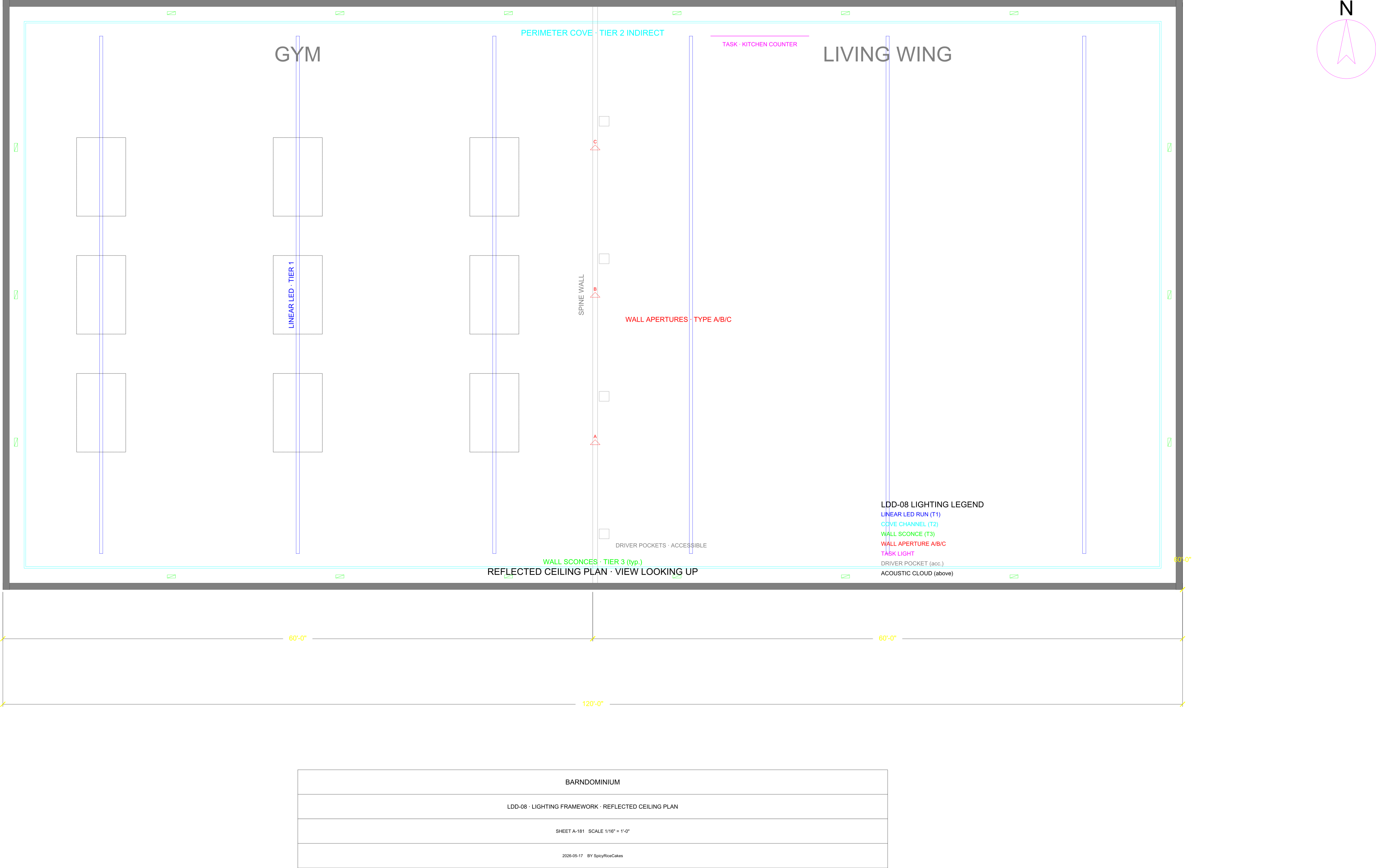
LDD-08 lighting framework diagram — placeholder for layered indirect system showing ambient cove, wall apertures, task drops, lamp positions, and low-level navigation glow
Lighting framework diagram — layered indirect, no visible sources. Generated plan diagram from the SpicyRiceCakes architecture toolchain. Click to enlarge.