PENDING LOCK 85°F cap + flush threshold are time-critical · Source: Peter Shin, 2026-05-15

LDD-24 · Flooring Systems + Threshold Integration

One-line intent

Flooring directly supports the operational and sensory needs of each zone, with a strictly flush, zero-threshold datum across the 60' spine wall opening.

Design intent · AI render

⚠️ STALE detail — flagged 2026-05-17. The urethane gym-floor description in this prompt is correct (matches Peter's revised spec). However, the striping description is incomplete — the prompt only mentions "faint volleyball court line markings". Per Peter's revised LDD-29 §27 the gym floor now carries permanent NCAA half-court basketball striping (primary, visually dominant) + beach volleyball striping (secondary, lighter overlay) in restrained charcoal-gray. Priority: MEDIUM — urethane visual is fine, but striping detail will read as wrong on close inspection. Update the inline prompt's striping language and regenerate via Codex when refreshed.
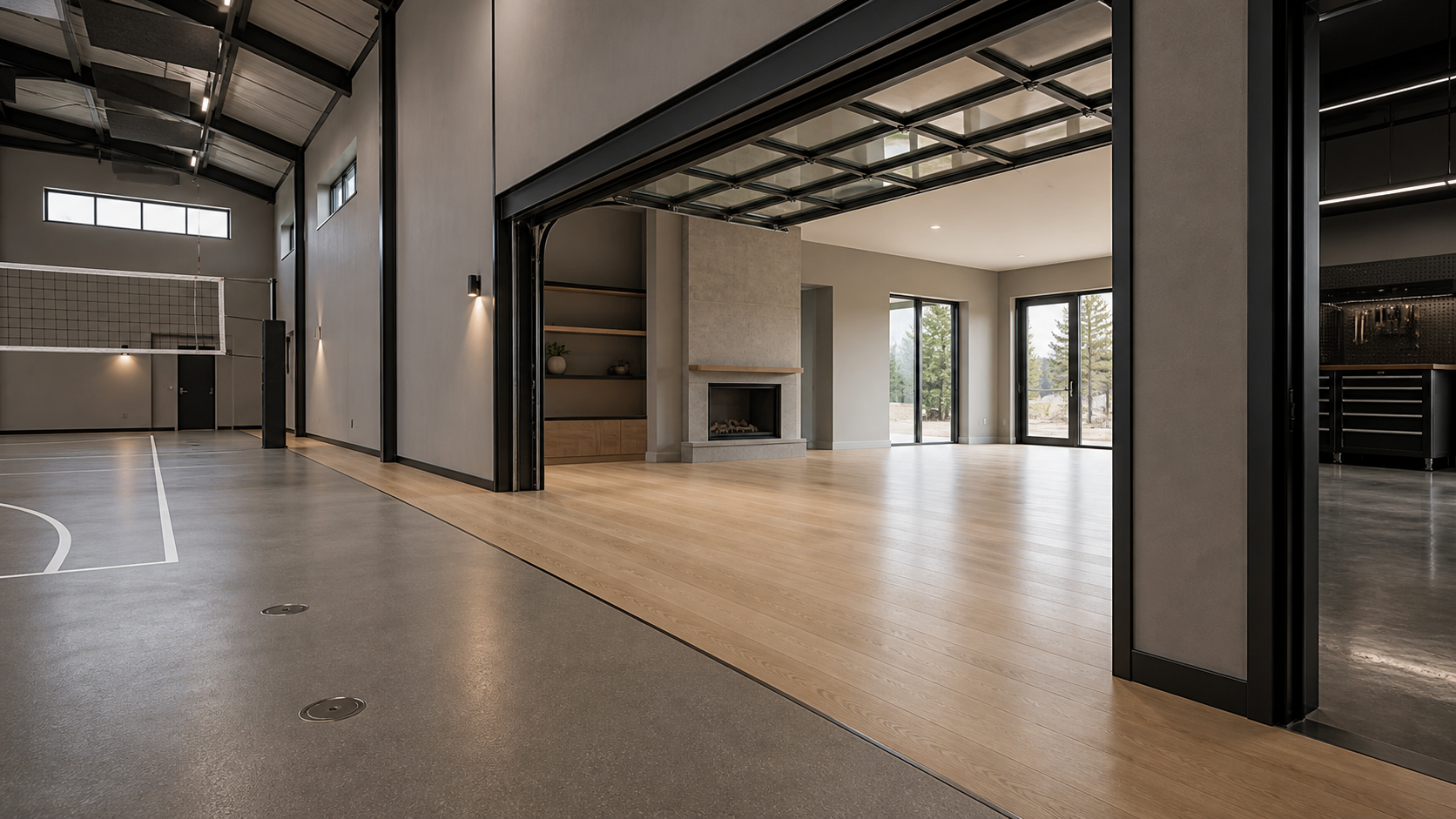
FPO · AI render AI-rendered architectural detail looking through the spine wall garage door opening — gym polyurethane athletic floor on the left meeting living-wing SPC LVP on the right in a 100% flush butt joint with a thin dark-bronze flush metal transition edge, no T-molding or step-up, slab pre-stepped 2-4mm at the gym side, calm midday daylight
Architectural intent render of the spine wall flush threshold — gym urethane meets living-wing SPC LVP at a perfectly flush butt joint, with the slab pre-stepped at the gym side so the finished floor reads as one continuous plane. For Position Only: AI-generated from the prompt below. Click to enlarge.
Codex prompt & how to regenerate

To regenerate: hand the prompt below to Codex / ChatGPT with image generation enabled (or any gpt-image-1 / DALL-E 3 endpoint), save the result as site/diagrams/24-flooring-fpo.png, redeploy. Page picks it up automatically.

Recommended params: model gpt-image-1, aspect 16:9, size 1536 × 1024.

Prompt:

Architectural interior rendering of the spine wall flush threshold — the moment where the gym's polyurethane athletic floor meets the living wing's SPC LVP across the 18'×10' glass garage door opening of the LDD-03 spine wall. Photoreal angled view from the gym side looking east into the living wing, captured at calm midday. 16:9 aspect. No people in frame. No furniture in the foreground.

Framing. Wide-angle composition (~24mm equivalent) at near-floor camera height (~3' AFF) angled slightly downward so the threshold line across the floor is the visual subject. The spine wall opening spans across the frame at center; the gym extends to the left of the opening, the living wing to the right of and through the opening. The 60' spine wall is partially visible above the 10'-tall opening.

The threshold (the subject of the render). A perfectly flush butt-joint between two different floor finishes runs across the foreground: LEFT of the threshold (gym side): poured polyurethane top coat over vulcanized rubber underlayment, soft warm-gray-brown matte color, restrained athletic floor texture, faint volleyball court line markings visible in receding perspective. The urethane assembly is ~8–10 mm thick. RIGHT of the threshold (living wing side, through the open garage door opening): high-density rigid-core SPC LVP in a calm warm white-oak look with very subtle wood grain, low-sheen matte finish. The LVP assembly is ~6–8 mm thick. Where they meet: a clean, dead-flat butt joint with a thin restrained matte dark-bronze flush metal transition edge (~5 mm wide), continuous across the full 18' opening width. The two floor surfaces sit at the EXACT SAME elevation — no T-molding, no step-up, no bevel, no trip-hazard. The slab beneath has been micro-stepped 2-4 mm on the gym side so the finished floor reads as one continuous plane across the threshold.

Spine wall + opening. The 60' spine wall above the opening reads as a calm continuous plane in medium warm gray, with the structural steel spine beam line visible above the 10' opening head. The 18'×10' glass garage door is in raised (open) position, frame visible at the top of the opening, dark bronze frame, clear glass panels.

Gym context (foreground / left). Polished urethane athletic floor receding leftward, very subtle court line graphics, two flush metal floor sleeve covers visible along the volleyball net centerline, calm medium warm-gray walls beyond, soft daylight ambient.

Living wing context (through the opening / right). SPC LVP floor in calm warm white-oak look receding rightward into the living wing volume. A glimpse of the radiant slab heat distribution implied (no visible HVAC). Calm interior daylight.

Workshop context (small inset visible at bottom-right of frame if possible, or implied beyond a doorway). A small slice of industrial sealed and polished concrete floor — Class 2-3 polish, soft matte sheen, very faint aggregate texture visible. Used only to suggest the third zone exists; not the focus.

Lighting mood. Calm, evenly exposed midday daylight. No dramatic shadows across the threshold. The floor finishes should read with their true colors — the urethane gym floor distinct from but harmonious with the SPC LVP — and the flush meeting should be the unambiguous visual subject.

Material palette. Warm soft-gray-brown urethane gym floor, warm white-oak SPC LVP, dark-bronze flush threshold metal edge, medium warm-gray walls, dark bronze door frame. No bright sport colors. No high-contrast finishes that would draw the eye away from the threshold.

What this is NOT (critical). Do NOT render with a T-molding, transition strip, step-up, bevel, threshold ramp, or any change in floor elevation across the spine wall opening. Do NOT show carpet or carpet tiles. NO loose-lay LVP, NO laminate, NO engineered wood with visible micro-bevels — the SPC LVP must read as one continuous plane. NO institutional gym striping or bright sport colors on the urethane. NO glossy polyurethane gym aesthetic. NO industrial warehouse concrete floor texture in the gym zone — that finish belongs only to the workshop/garage zones (cameo inset). NO thick rugs anywhere. NO trip hazard of any kind through the threshold. NO decorative inlay or pattern at the threshold.

Style direction. Professional architectural visualization, photoreal, evenly exposed. Calm and quiet mood. Sharp focus throughout (especially at the threshold line), no shallow DOF. Should feel like an architecture-monograph detail photograph illustrating "100% flush threshold between dissimilar floor systems," not a flooring-catalog product shot.

System allocation by zone

ZoneSystemReason
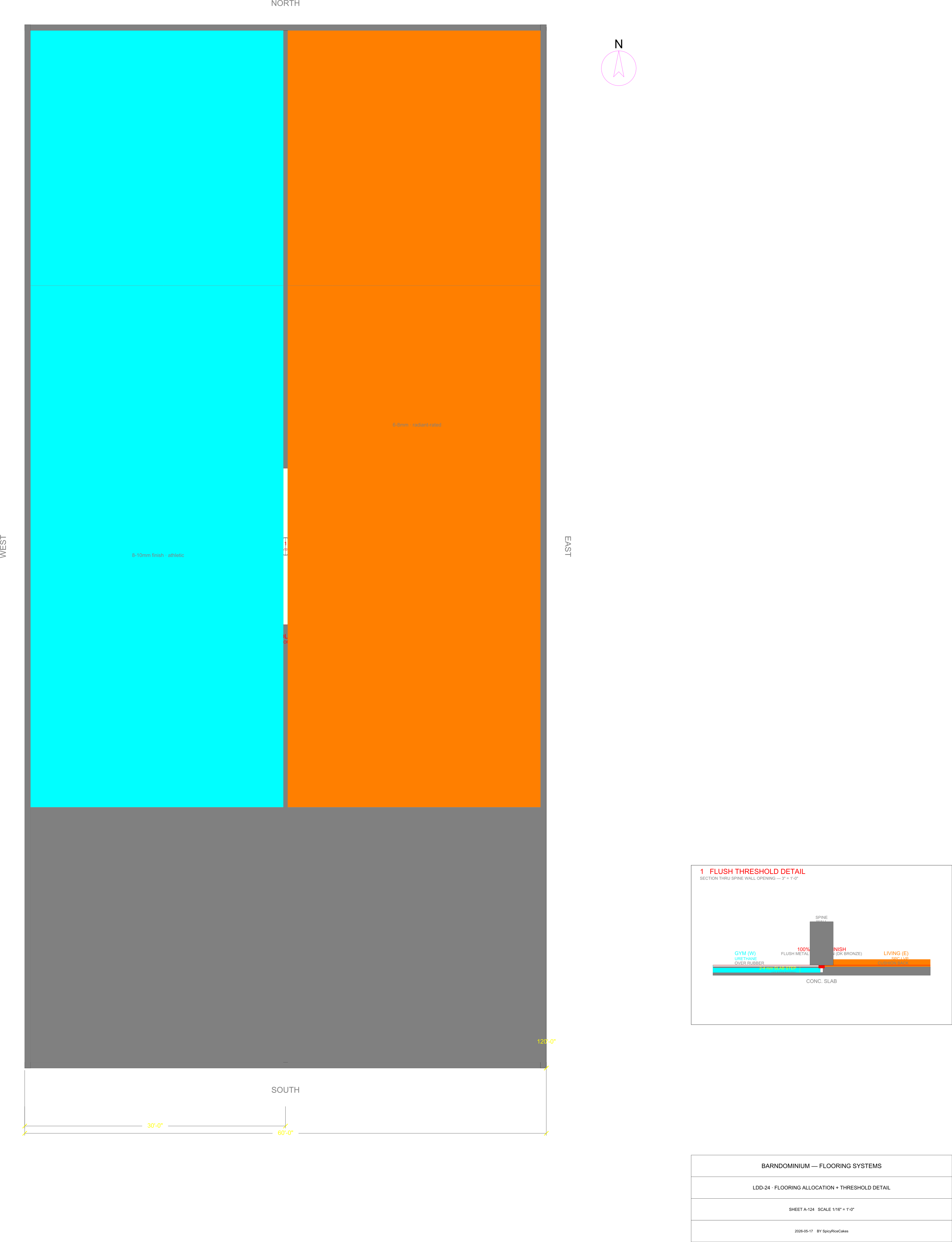
Gym (west of spine)Poured polyurethane top coat over vulcanized rubber underlaymentShock absorption · acoustic dampening · longevity under athletic loads
Living wing / ILS (east of spine)High-density rigid-core SPC LVP with factory-attached cushion (IXPE foam or engineered cork)Thermal stability over radiant · standing comfort · room acoustics
Workshop / parking / mech (south + central service)Industrial sealed and polished concretePer foundation LDD; durable, cleanable, vehicle-rated

Radiant compatibility constraints

Spine wall threshold mandate

Zero Improvisation Rule

Gym urethane assembly (~8–10mm) is thicker than residential SPC LVP (~6–8mm).

The underlying structural concrete slab must be micro-adjusted or self-leveled across the threshold of the 18'×10' glass garage door along the 60' spine wall.

Outcome: 100% flush finished floor. No T-moldings, step-ups, bevels, or trip-hazards through the spine wall opening.

✅ Pier foundation cascade — withdrawn 2026-05-15 PM

Per builder rebuttal: in PEMB-residential, "piers" = subterranean concrete column footings + grade beams. The first-floor finish remains a continuous monolithic slab-on-grade. No wood-subfloor-on-piers assembly. Flooring strategy applies as written. The spine wall flush threshold is now solved at the formwork stage with a 2–4mm step-down on the gym side — no retrofit overlay needed.

Open items / engineer review

Cost drivers

Gym urethane (~1,800 sqft × $9–16) $16–30K · SPC LVP (~4,200 sqft × $5–10) $21–42K · Polished concrete (~2,400 sqft × $4–9) $10–22K · Self-leveling overlay at threshold $0.5–1K · Court lines $1.5–4K · Transition strip $0.5–2K. Total: $50–95K — was missing from original waterfall, now added.

Air-gap concerns

  1. The 85°F slab cap is the most important interlock. Comfort-density radiant in cold-climate January can push slab to 90–95°F. Mechanical designer must calibrate so LVP zone never exceeds 85°F continuous. Verify in writing with LVP manufacturer.
  2. Self-leveling across spine threshold is a real construction sequencing challenge. Build into schedule, not "we'll do it during finish."
  3. Vulcanized rubber + urethane gym — pro-grade gym feel; weekend league play may feel "spongier" than expected. Set expectations.
  4. Polished concrete in mech room slippery when wet. Spec slip-rated finish (DCOF ≥ 0.42 wet).
  5. Workshop concrete + tool drops — chips show. Consider urethane cement overlay at bench main work zone (+$2.5–4K).
  6. Off-gassing during first 30 days — plan 14-day flush-out window with high ventilation.
  7. No thick rugs on heated zones — document in homeowner manual.

Cross-references

→ Outputs to

LDD-02 85°F cap · LDD-03 flush threshold mandate · LDD-22 hoop anchor through urethane

← Inputs from

LDD-18 material language · LDD-01 slab elevations

Diagram

Plan view of the three-zone flooring allocation across the 60-by-120 footprint — gym west of spine wall in urethane, living/ILS east of spine in SPC LVP, workshop and parking and mech in polished concrete, with the spine wall flush threshold line highlighted
Three-zone flooring allocation across the building footprint — gym (urethane) · living/ILS (SPC LVP) · workshop/garage/mech (polished concrete) — with the spine wall flush threshold highlighted. Generated plan diagram from the SpicyRiceCakes architecture toolchain. Click to enlarge.