LOCKED infrastructure strategy correct

LDD-09 · Electrical System

One-line intent

Distributed, zone-aligned electrical with centralized service and localized subpanels — no over-centralized "smart house" dependency.

Design intent · AI render

FPO · AI render AI-rendered architectural visualization of the laundry / operations core — main 400A panel surface-mounted to a warm-gray wall, labeled subpanels below, multiple parallel EMT conduit runs turning 90° to head to the ceiling, exposed PEMB structure overhead, calm service-grade room with stainless utility sink and warm white-oak folding ledge
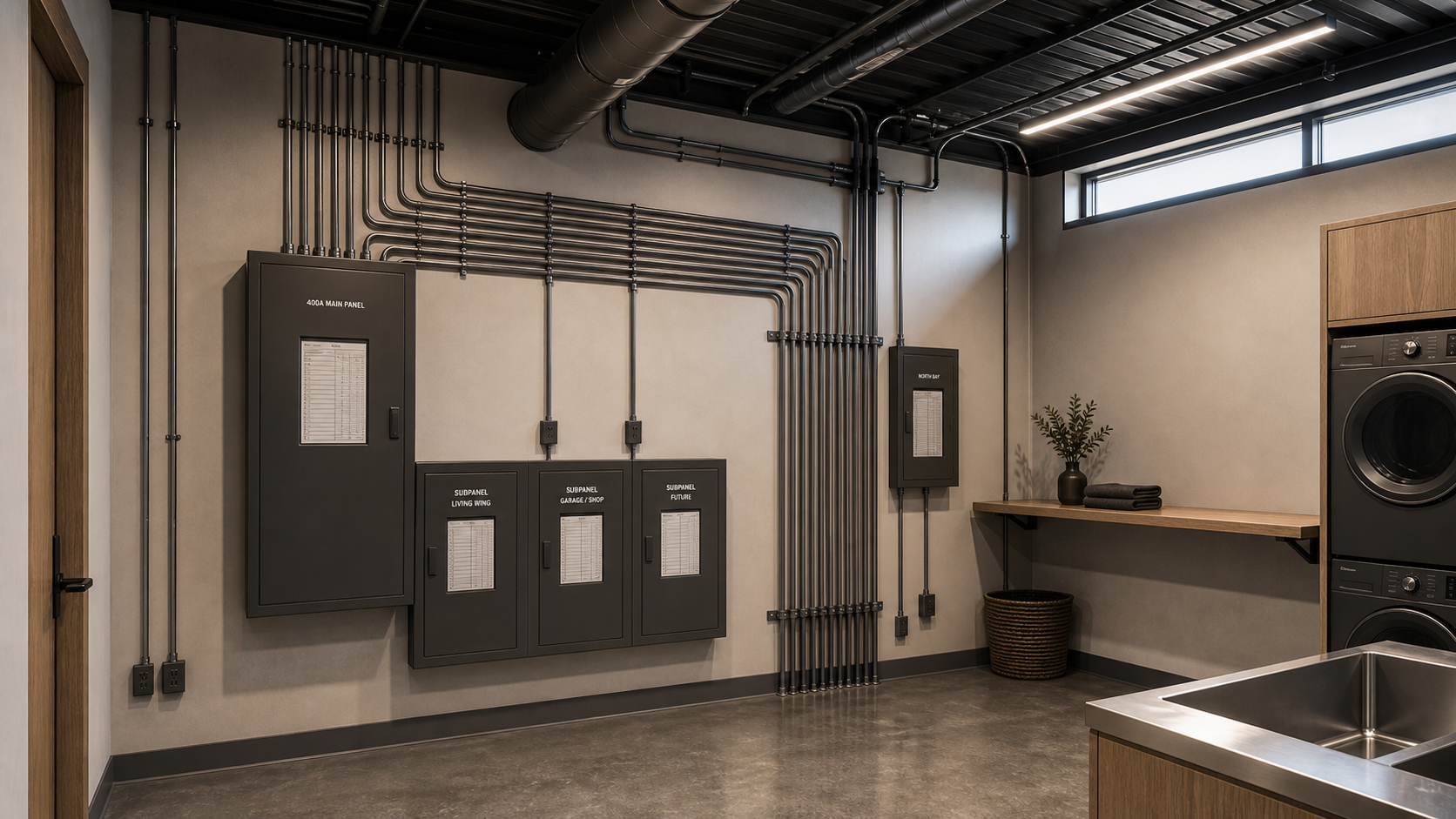
Architectural intent render of LDD-09's main panel siting + disciplined parallel-only conduit routing. For Position Only: AI-generated from the prompt below. Click to enlarge.
Codex prompt & how to regenerate

To regenerate: hand the prompt below to Codex / ChatGPT with image generation enabled (or any gpt-image-1 / DALL-E 3 endpoint), save the result as site/diagrams/09-electrical-fpo.png, redeploy. Page picks it up automatically.

Recommended params: model gpt-image-1, aspect 16:9, size 1536 × 1024.

Prompt:

Architectural interior rendering of the laundry / operations core of a luxury barndominium, illustrating LDD-09's main electrical panel siting and disciplined exposed conduit routing. Wide-angle photoreal view of a calm service-grade room with the main electrical panel mounted on one wall, conduit bundles running cleanly to the ceiling, and a labeled subpanel on the adjacent wall. 16:9 aspect. No people in frame. Bright neutral daylight from a clerestory above so the wiring discipline is visible.

Spatial framing. Eye-level perspective (~5'-6" camera) at ~24mm full-frame equivalent, three-quarter view of a corner that shows two walls + ceiling + floor. The room is the laundry / operations zone — clean, durable, with a stainless utility sink at the edge of frame, a stacked washer/dryer half visible, and a wall-mounted folding ledge in warm white oak. The room reads as service infrastructure made architecturally calm.

Main electrical panel (focal feature). A clean dark matte-finish 400A main panel surface-mounted to a medium warm-gray wall, with a typed engraved schedule card under a clear cover. Below the panel: a neat row of three labeled subpanel surfaces (or one subpanel + room for two more), each with a clearly typed legend strip. Surface trim is restrained dark-bronze metal, not chrome, not exposed copper. Above the panel: a clean horizontal trough of conduit (~3'-6" wide band) where multiple parallel EMT conduit runs emerge from the panel and turn 90° to head toward the ceiling — all parallel, none crossing, all clipped at regular intervals to a steel strut backplate.

Conduit routing (illustrating LDD-09 routing rules). Several parallel rigid metal conduit runs (EMT, dark powder-coat or matte-galvanized finish) run cleanly up the wall in a tight vertical band, then turn 90° at a single elevation and continue horizontally along the wall/ceiling junction. NO diagonal runs. NO crossing. NO zip ties — only proper one-hole straps and steel strut. The drops to outlets are clean vertical runs only. The visual reading is "this was designed, not improvised."

Ceiling. Exposed PEMB structure (primary purlins, secondary framing) in dark charcoal, NOT concealed. A main HVAC trunk (round duct, dark) runs N-S above the conduit band. Smaller branch ducts and lighting runs are visible and orderly. The five-layer hierarchy of LDD-12 is legible: structure highest, HVAC trunk next, branch ducts, electrical conduit, then lighting below.

Material palette. Medium warm-gray wall fields, soft charcoal floor (polished concrete or epoxy), dark charcoal exposed PEMB, matte dark-bronze metal systems, warm white-oak utility ledge, no chrome. No bright sport colors.

Lighting mood. Bright neutral working daylight from a clerestory or skylight above — this is a service room, the goal is to see the discipline of the wiring, not to set evening mood. Linear LED runs mounted tight to structure provide additional even fill at lower intensity. No visible bulbs.

What this is NOT (critical). Do NOT render as: a chaotic basement panel scene, a commercial-electrical-room aesthetic with yellow caution stripes and orange-handled disconnects, a steampunk industrial loft with theatrically exposed wiring, or a sterile data center. NO Romex/NM cable visible outside the panel — only proper conduit. NO bare bulbs. NO zip ties. NO diagonal runs. NO crossing conduits. NO unlabeled panels. NO bright primary colors.

Style direction. Professional architectural visualization, photoreal, evenly exposed. The render's job is to make a 400A panel + multiple subpanels + organized parallel conduit look architecturally calm and intentional — like the panel and conduit are part of the architecture, not a violation of it. Sharp focus throughout. Camera neutral, no shallow depth-of-field.

Locked decisions

Open items / engineer review

Cost drivers

400A service entrance + main $8–15K · Two subpanels $4–8K · EV stub-outs $2–4K · Solar PV-ready $1–3K · Generator-ready $2–4K · Whole-house wiring + devices $60–95K. Total: $75–125K, budgeted at $110K.

Air-gap concerns

  • Pick 400A now. Upgrading later = $8–15K + downtime.
  • Missing low-voltage / structured wiring spec. Cat6 to TVs, APs, doorbell — easier in rough than retrofit.
  • No surge protection — $400–1,200 installed; without it, low-voltage drivers + electronics at risk.
  • Workshop subpanel undersized? "Future loads" is vague. Spec 100A min, 125A if welder/CNC possible.
  • Generator gas line needs Phase 1 stub-out if propane/NG.

Cross-references

← Inputs from

LDD-08 · LDD-05 · LDD-21 main panel siting

→ Outputs to

LDD-23 conduit discipline

Diagram

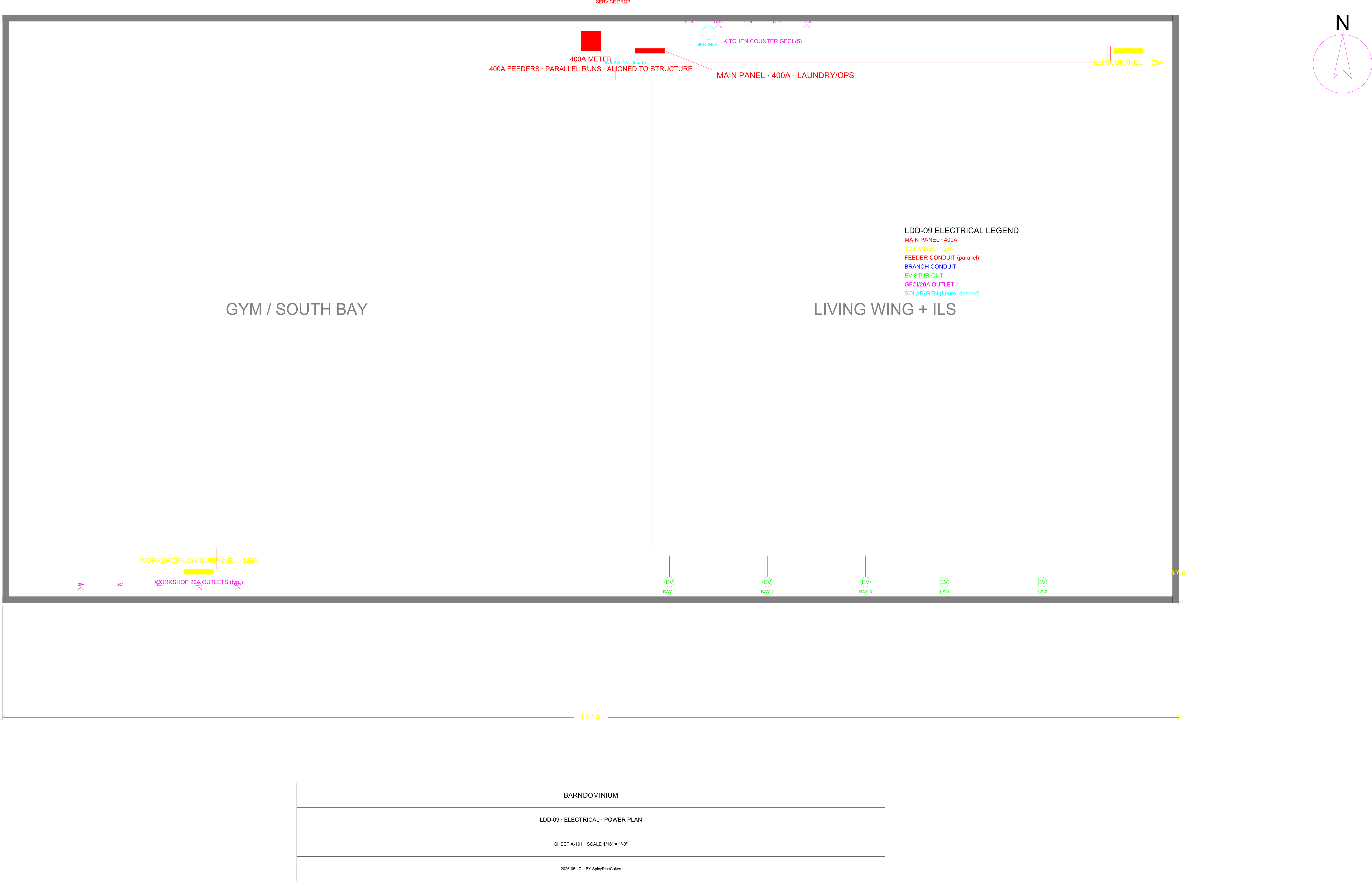
LDD-09 electrical infrastructure diagram — generated diagram showing main panel + 2 subpanels + EV stub-outs + parallel conduit discipline across the building footprint
Electrical infrastructure diagram — main panel in laundry/ops, ILS + workshop subpanels, EV stub-outs, parallel conduit runs aligned to structure. Generated plan diagram from the SpicyRiceCakes architecture toolchain. Click to enlarge.