LOCKED v2.0 most disciplined LDD in the set

LDD-10 · Plumbing — Three Clusters

📋 Unified by LDD-30 Central Mechanical Core Master Strategy (v6.0, 2026-05-17). LDD-30 §3 + §13 + §18 codify the T&P + emergency thermal discharge routing to the mech-room east-wall floor drain, peak simultaneous demand sizing basis, and indirect tank capacity requirements driving the dual-source DHW strategy.

One-line intent

Three zones, tight stacks, short runs — everything falls cleanly to the east.

Design intent · AI render

FPO · AI render AI-rendered cutaway visualization of the middle plumbing cluster — two-story partial section through a wet wall showing one dead-vertical 4-inch waste stack, parallel hot+cold supply lines, toilet branches under 8 feet to stack, and an east-falling under-slab main drain with cleanout, with a calm kitchen on the ground floor and laundry/ops above shown in elevation around the section
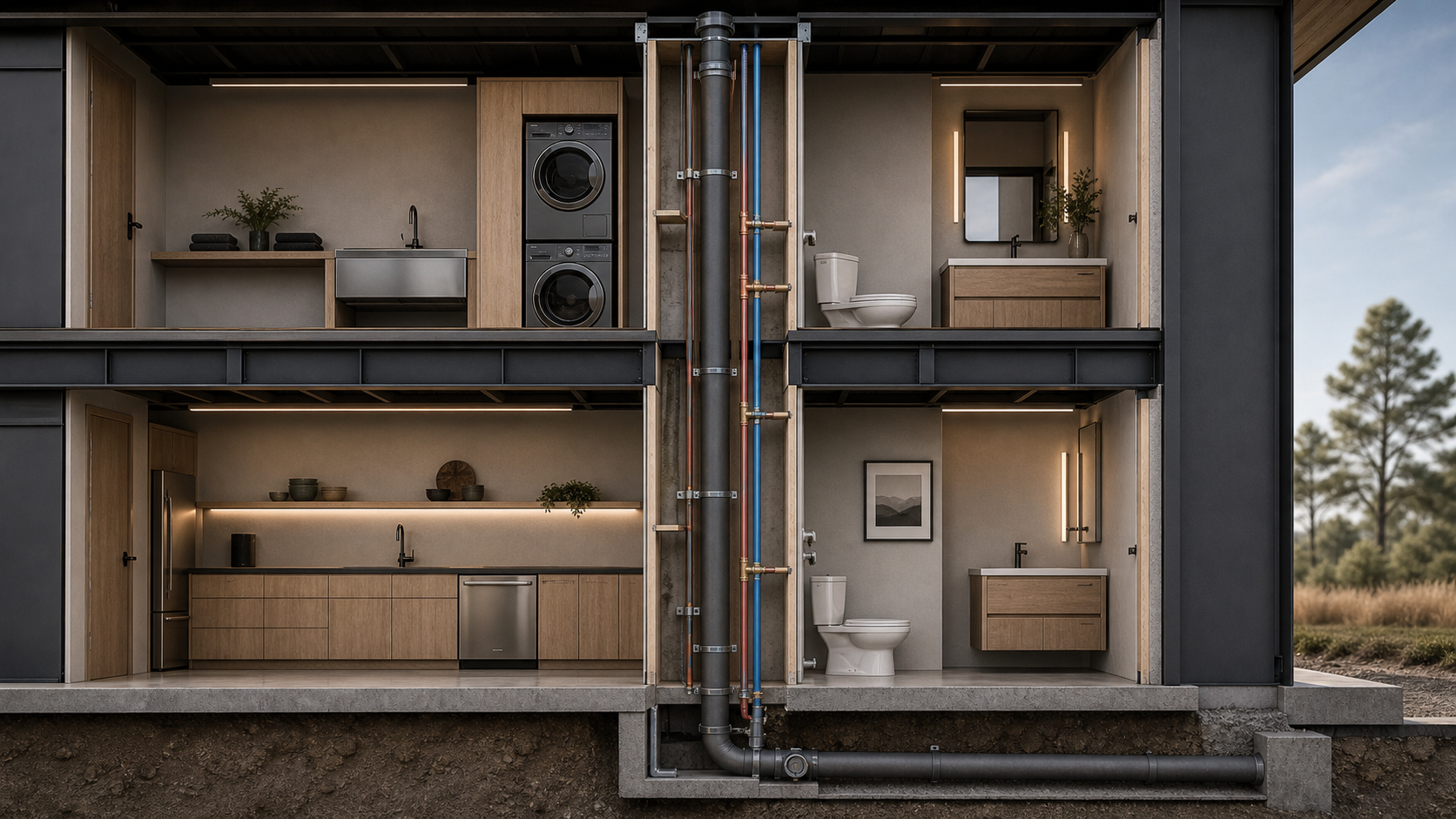
Architectural cutaway intent render of LDD-10's "tight stacks, short runs, falls cleanly to the east" thesis. For Position Only: AI-generated from the prompt below. Click to enlarge.
Codex prompt & how to regenerate

To regenerate: hand the prompt below to Codex / ChatGPT with image generation enabled (or any gpt-image-1 / DALL-E 3 endpoint), save the result as site/diagrams/10-plumbing-fpo.png, redeploy. Page picks it up automatically.

Recommended params: model gpt-image-1, aspect 16:9, size 1536 × 1024.

Prompt:

Architectural cutaway rendering of the middle plumbing cluster in a luxury barndominium — a two-story partial-section view through a wet wall, illustrating LDD-10's "three zones, tight stacks, short runs, everything falls cleanly to the east" thesis. 16:9 aspect. No people in frame. Calm neutral daylight from outside the section. Photoreal materials, not a schematic diagram — but the wall is sliced away so the plumbing inside is visible.

Section framing. Two stories of a luxury residence shown in clean orthographic-leaning cutaway: ground-floor kitchen on the left with a kitchen sink + dishwasher visible at counter level, upper floor laundry/ops core directly above with a washer and a 3-piece bath beyond. The cutting plane runs through a single wet wall between the two floors so the wet wall is in section and the rooms are in elevation. The wet wall is the protagonist.

Wet wall (focal feature, in section). A vertical wet wall sliced open so the viewer can see inside. Inside the wall:
- A single primary vertical waste/vent stack (4" cast iron or PVC) running floor-to-roof, dead vertical, no offsets. Toilet branches enter the stack at <= 6'-8" horizontal run on each floor.
- Two parallel supply lines (hot + cold, PEX in red and blue or copper) running vertically beside the stack, with neat T-branches to fixtures on each floor.
- A floor slab horizontal section showing the under-slab portion of the stack turning 90 degrees east into the main building drain.
- A vent termination through the roof at the top of the stack.
All piping is clean, parallel, vertical. No diagonal runs. No tangles.

East main drain (in foreground floor section). Below the ground-floor slab, a section cut shows the under-slab east main drain running left-to-right (N->S) collecting from the wet wall and continuing toward the east side of the building. A cleanout fitting at the cluster intersection is visible. The drain reads as a single clean east-falling line, not a tangle.

Rooms (in elevation, around the section). The kitchen on the ground floor is restrained — medium warm-gray walls, warm white-oak cabinetry, soft charcoal counter, undercounter task light beneath a floating shelf. The upper laundry/ops is also restrained — stainless utility sink, stacked washer/dryer, warm white-oak folding ledge. The rooms are calm; the cutaway plumbing is what the eye is drawn to.

Material palette (rooms). Medium warm-gray walls, soft charcoal floors, dark charcoal exposed PEMB structure visible at the ceiling of each floor through the cutaway, warm white-oak accents, restrained dark-bronze metal trim. Plumbing palette (inside the wet wall): cast iron or matte PVC for the DWV stack, copper or PEX for supply, no chrome, no exposed traps in the section, all fittings sweated/glued/clamped properly. The discipline reads as the message.

Lighting mood. Calm neutral daylight from outside the section frame, no dramatic shadow. The cutaway interior of the wet wall is evenly lit so all the pipe runs are clearly readable. Linear LED runs visible at the ceiling of each finished room provide ambient illumination.

What this is NOT (critical). Do NOT render as: a code textbook isometric diagram, a black-and-white technical drawing, a tangle of spaghetti pipes through a stud wall, a typical residential mechanical-room photo with random fittings everywhere, or a Home Depot bathroom display. NO PVC primer purple stains. NO unsupported pipe runs. NO horizontal toilet branches longer than 8 feet. NO diagonal pipe runs anywhere. NO crossing pipes. NO bright primary colors. NO chrome.

Style direction. Professional architectural visualization, photoreal materials but with the wet wall sliced cleanly away so the plumbing inside reads. Think of an architectural firm's published wet-wall section drawing rendered as a photo, not as a CAD line drawing. Calm camera, slight isometric tilt acceptable, sharp focus throughout, no shallow depth-of-field. The viewer should walk away saying "every pipe was designed."

Three independent clusters

North cluster

Middle cluster (highest density)

South cluster

Non-negotiable rules

Open items / engineer review

Cost drivers

DWV $2–5K · Supply piping $22–43K · Fixtures (7 toilets, 10 sinks, 3+ showers) $25–45K · Hot water system $4–12K · Softener $2–6K. Total: $90–135K, budgeted $115K.

Air-gap concerns

  • ILS kitchen sink offset is the only weak point — document under-slab routing.
  • Hot-water wait at ILS kitchen without recirc — daily friction.
  • Slab penetrations vs radiant tubing — plumbing wins, radiant routes around. Coordinate.
  • East main drain spans 120' — single drain failure disrupts whole building. Add cleanouts at each cluster.
  • Vent stacks pierce roof — locate now to align with bays.

Cross-references

→ Outputs to

LDD-15 · LDD-13 · LDD-21

← Inputs from

LDD-02 radiant tubing coordination

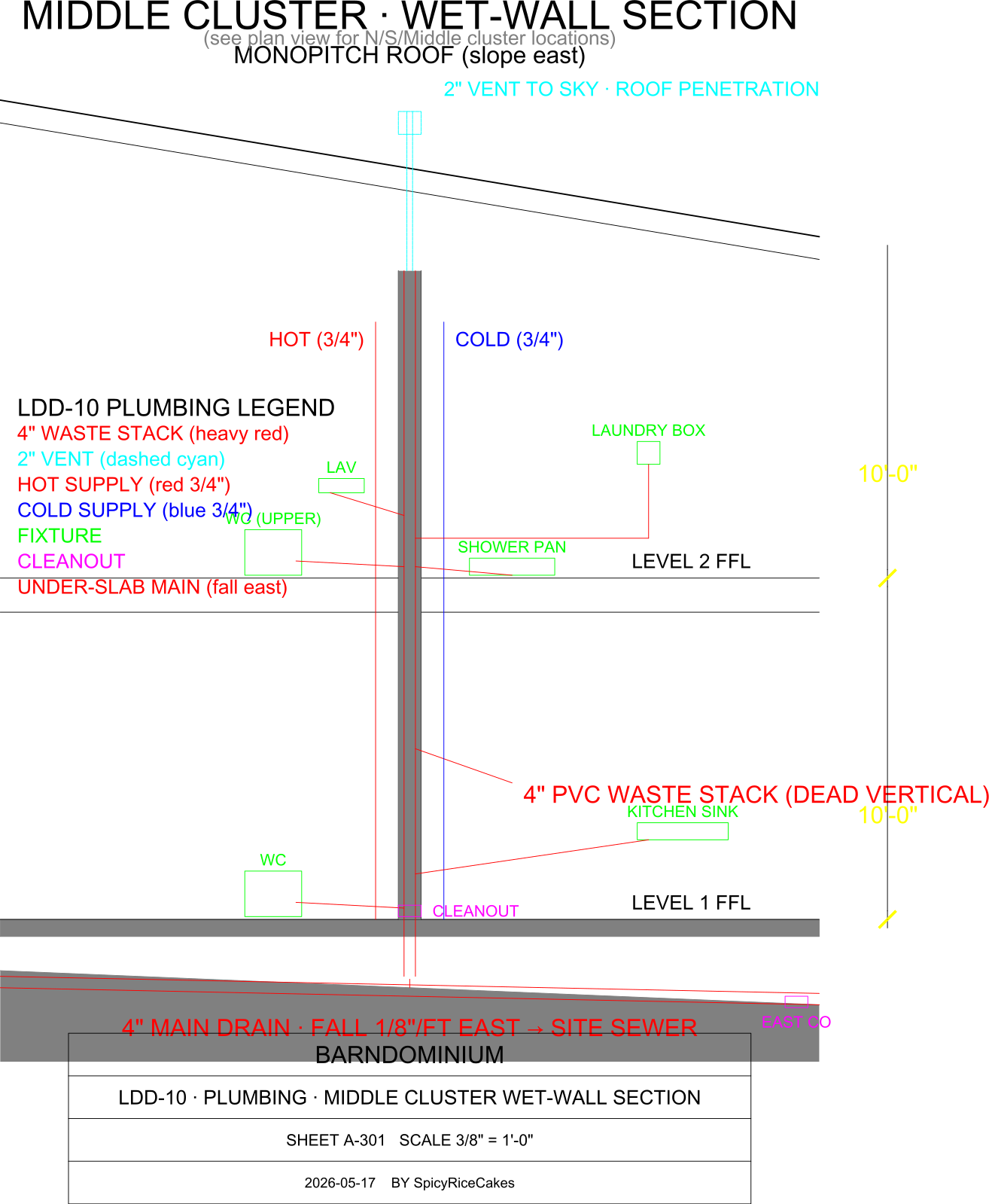
Diagram

LDD-10 plumbing diagram — generated diagram showing three vertical stacks (north, middle, south cluster) connecting to the east-side under-slab main drain heading to the site sewer
Three plumbing clusters · east-side under-slab main drain · site sewer connection. Generated plan diagram from the SpicyRiceCakes architecture toolchain. Click to enlarge.