LOCKED — but tight strategy clear, size questionable

LDD-15 · Mechanical Room

⚠️ Superseded in parts by LDD-30 Central Mechanical Core Master Strategy (v6.0, 2026-05-17). Peter's revised spec moves the electrical subpanel + battery OUT of this room (electrical now in LDD-21 Zone 2, battery now in LDD-13 Zone 3). East wall now houses the indirect storage tank + emergency floor drain; west wall houses the MUA fan cabinet + utility sink. The "Zones" table and AI render on this page are now stale — see stale markers below.

One-line intent

Organized systems, partially revealed — the room is the project's mechanical infrastructure read as architectural feature.

Design intent · AI render

⚠️ STALE render — flagged 2026-05-17. This image depicts the OLD east-wall allocation (electrical subpanel + battery enclosure on right). Per LDD-30 §3 + §13–§14, the east wall now houses the indirect storage tank + emergency floor drain; the west wall now houses the MUA fan cabinet + utility sink; the electrical subpanel has moved to LDD-21 (Zone 2) and the battery has moved to LDD-13 (Zone 3). Priority: HIGH — this is the marquee render for the mech room and is now fundamentally wrong. Update the inline prompt below (delete subpanel + battery from east wall, add MUA cabinet to west wall, move utility sink + add indirect tank to correct flanks) and regenerate via Codex.
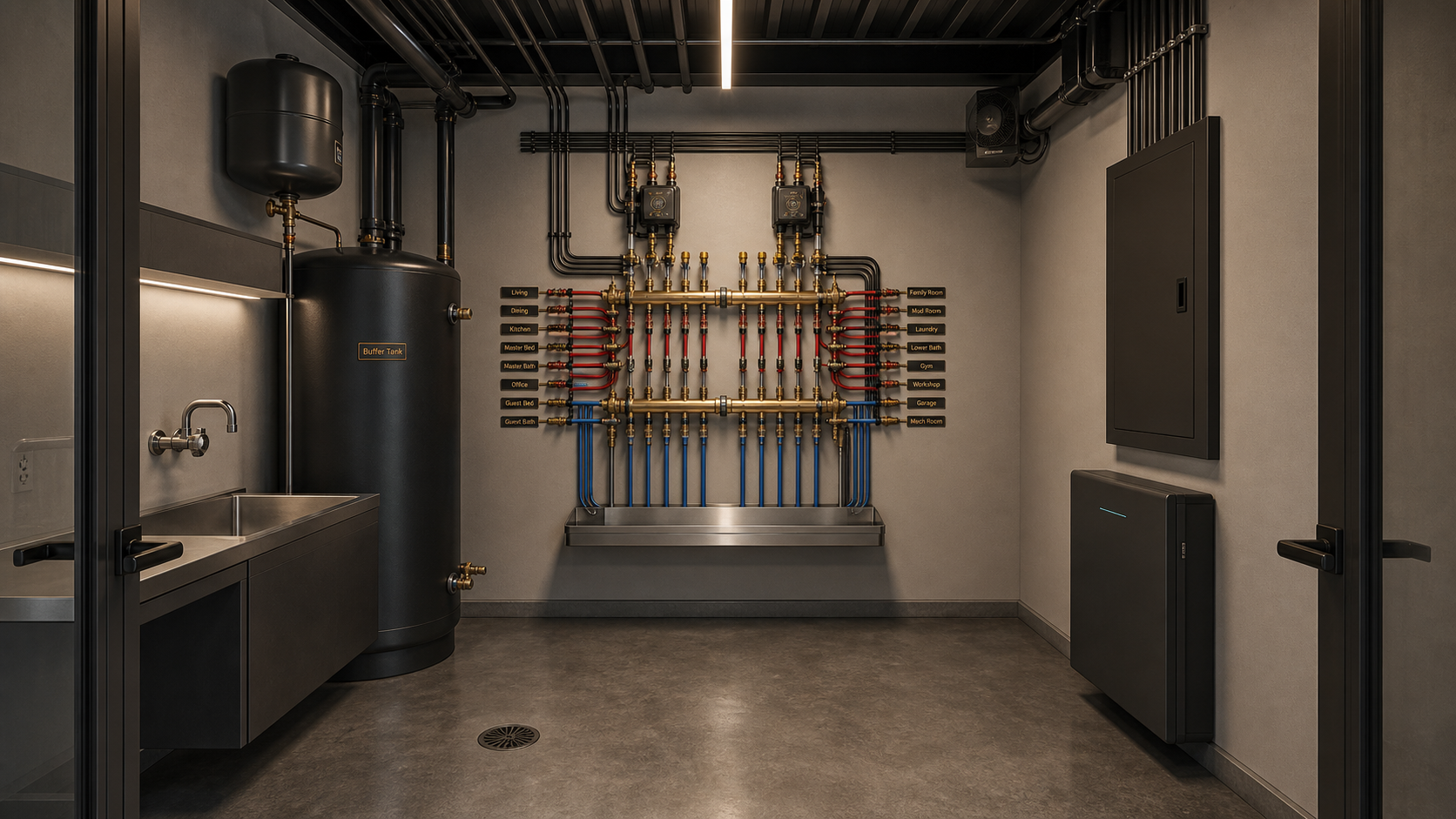
FPO · AI render AI-rendered architectural visualization of the mechanical room — interior view from the smoked-glass door looking north toward the radiant manifold visual wall with polished brass distribution headers and labeled PEX loops, vertical buffer tank and utility sink at left, flush dark-bronze electrical subpanel and wall-mounted battery at right, sealed warm-gray polished concrete floor with a recessed floor drain, exposed dark-charcoal PEMB structure overhead
Architectural intent render of the mech room — the manifold reads as composition, glimpsed through a smoked-glass door. For Position Only: AI-generated from the prompt below. Click to enlarge.
Codex prompt & how to regenerate

To regenerate: hand the prompt below to Codex / ChatGPT with image generation enabled (or any gpt-image-1 / DALL-E 3 endpoint), save the result as site/diagrams/15-mech-room-fpo.png, redeploy. Page picks it up automatically.

Recommended params: model gpt-image-1, aspect 16:9, size 1536 × 1024.

Prompt:

Architectural interior rendering of a small, disciplined mechanical room — roughly 10' × 7' × 9' tall — inside a luxury barndominium residence. View from just inside the smoked-glass entry door looking straight north toward the radiant-manifold visual wall. Wide-angle photoreal still life, 16:9 aspect, no people in frame.

Spatial setup. The room is tight but legible: a 10' deep × 7' wide rectangle. The viewer stands at the south wall (where the smoked-glass door is implied behind the camera). The north wall directly ahead carries the radiant manifold — the room's "feature wall." The east wall (right of frame) carries the electrical subpanel and a wall-mounted battery enclosure. The west wall (left of frame) carries vertical tanks and a small utility sink. The center of the room is kept clear for service access.

North wall — the manifold visual wall (background of frame). A single calm medium-warm-gray painted wall hosts a beautifully composed radiant heating manifold cluster — polished brass distribution headers with neatly arranged supply/return loops in red and blue PEX, each circuit clearly labeled with discreet engraved nameplates. The loops fan out left and right symmetrically. Above the manifold, two small circulation pumps in dark charcoal housings; below, a clean horizontal stainless drip tray. All conduit and pipe runs are orderly, parallel, banded together with restrained dark metal cable tray. This is the wall that justifies the smoked-glass door — it reads as architectural composition, not utility chaos.

West wall (left of frame). A vertical buffer tank in matte dark-charcoal jacket, an expansion tank above, a small utility sink at counter height in brushed stainless with a wall-mounted single-handle faucet, and a floor drain visible at the wall/floor junction. Tank labels are discreet small dark-bronze plaques.

East wall (right of frame). A flush-mount dark-bronze electrical subpanel cabinet, ~24" × 36", door closed, with neat conduit entries banded at the top. Below it, a wall-mounted lithium-ion battery enclosure (Powerwall-style form factor) in matte charcoal with a faint indicator LED.

Floor. Sealed polished concrete with a subtle dark warm-gray finish. A single recessed circular floor drain near the center-west of the room.

Ceiling. Exposed PEMB steel structure (primary purlins, secondary framing) in dark charcoal, NOT concealed. A single linear LED strip runs centered down the room's long axis, casting a clean even wash. A small inline ventilation fan housing is visible in the upper corner near the east wall, tied to a short duct stub.

Foreground frame (south wall, behind viewer). Just enough of the smoked-glass door's interior reveal is visible at the bottom corners of the frame to ground the composition — a slim dark-bronze door frame and a hint of frosted-gray smoked glass.

Lighting mood. Cool and clean but warm-toned. The single overhead linear LED at 3000K is the primary source. Indirect glow from a small under-counter strip at the sink. The mood is "the inside of a Swiss watch" — quiet, precise, slightly proud. Not horror-basement, not warehouse mechanical room.

Material palette. Medium warm-gray painted walls, sealed dark warm-gray concrete floor, dark charcoal exposed PEMB structure overhead, brushed stainless sink and drip tray, polished brass manifold headers (the room's only warm-metallic accent), matte charcoal tank jackets and battery enclosure, dark-bronze subpanel and door frame. No bright colors except the small red/blue PEX loop pairs, which read as functional labeling not decoration.

What this is NOT (CRITICAL). Do NOT render as: a residential basement utility closet, a boiler room, a server room, a janitor's closet, a commercial mechanical penthouse, or an industrial plant room. NO bare incandescent bulbs. NO dangling spaghetti of unbanded wires. NO rust. NO grime. NO chaotic exposed flexible duct. NO HVAC industrial signage. NO fluorescent shop lights. NO wood-framed walls with open insulation. NO concrete unfinished beyond a basic polish.

Style direction. Professional architectural visualization, photoreal, evenly exposed. Calm, quiet, almost reverent mood — this is a room that's secretly proud of itself. Neutral camera at eye-level (~5'-6"), wide angle equivalent to ~22mm full-frame to capture all three walls, sharp focus throughout, no shallow DOF. The render should feel like the inside cover of a mechanical-systems design monograph, not a contractor's job-site photo.

Locked decisions

Zones

⚠️ SUPERSEDED by LDD-30 §13–§14 (2026-05-17). The east-wall = electrical + battery allocation below is the OLD spec. New zone allocation (binding):

WallNEW function (per LDD-30 v6.0)
NorthRadiant manifold (visual wall) — unchanged
EastIndirect storage tank + emergency floor drain (was electrical + battery)
WestMUA fan cabinet + vertical duct drop + utility sink (was tanks + sink)
Center48" continuous service aisle (was working space)

The old zone table is preserved below for historical context but should NOT be used for bidding or construction.

ZoneFunction (OLD — pre-LDD-30)
NorthRadiant manifold (visual wall)
SouthTanks + sink
EastElectrical + battery (now in LDD-21 + LDD-13 per LDD-30)
CenterWorking space (service access)

Open items / engineer review

Cost drivers

Smoked glass door $2–6K · Mech room finishes $2–5K · Floor drain + sink $1.5–3K · Ventilation $0.5–1.5K. Total: $5–15K (room only; equipment in respective LDDs).

Air-gap concerns

  • 70 sqft is genuinely tight. Typical equivalent room is 80–120 sqft. Recommend bumping to ≥90 sqft (10'×9' or 12'×7.5') before structure is set.
  • HPWH in small mech room loses efficiency — vent ducts to larger space or pick different water heater.
  • Smoked glass door + visible infrastructure = real commitment. Every label/cable tie/pipe stub matters.
  • Battery code + safety implications — Powerwall/Enphase need fire separation + ventilation per code.
  • Floor drain coordination with under-slab plumbing.
  • Single mech room may be insufficient — north + south alcoves implied by 3-cluster strategy but not explicit.

Cross-references

← Inputs from

LDD-02 central manifold · LDD-05 equipment · LDD-10 middle cluster

→ Outputs to

LDD-06 local south service branch from here

Diagram

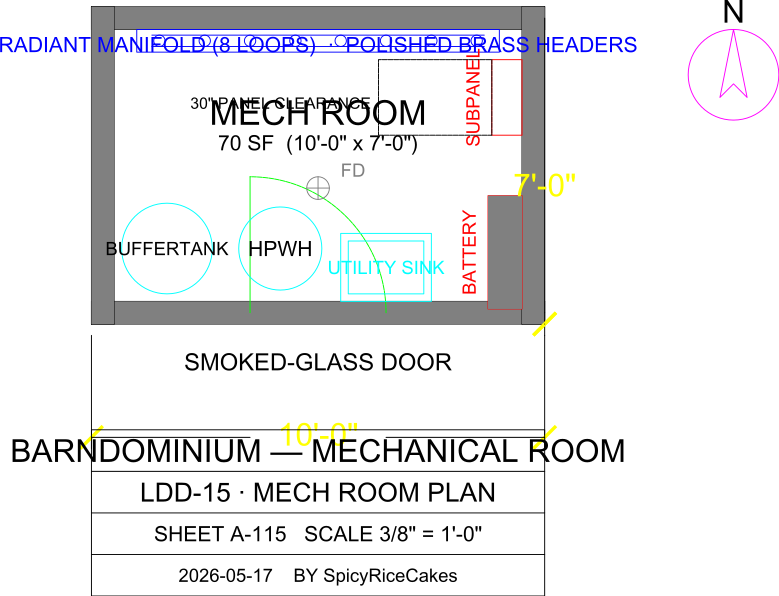
Mechanical room plan — 10'×7' room with north radiant manifold wall, south tanks + sink, east electrical + battery, smoked-glass door, central service-access space
Mech room plan, ~10' × 7'. Smoked-glass door at south; manifold visual wall at north. Generated plan diagram from the SpicyRiceCakes architecture toolchain. Click to enlarge.