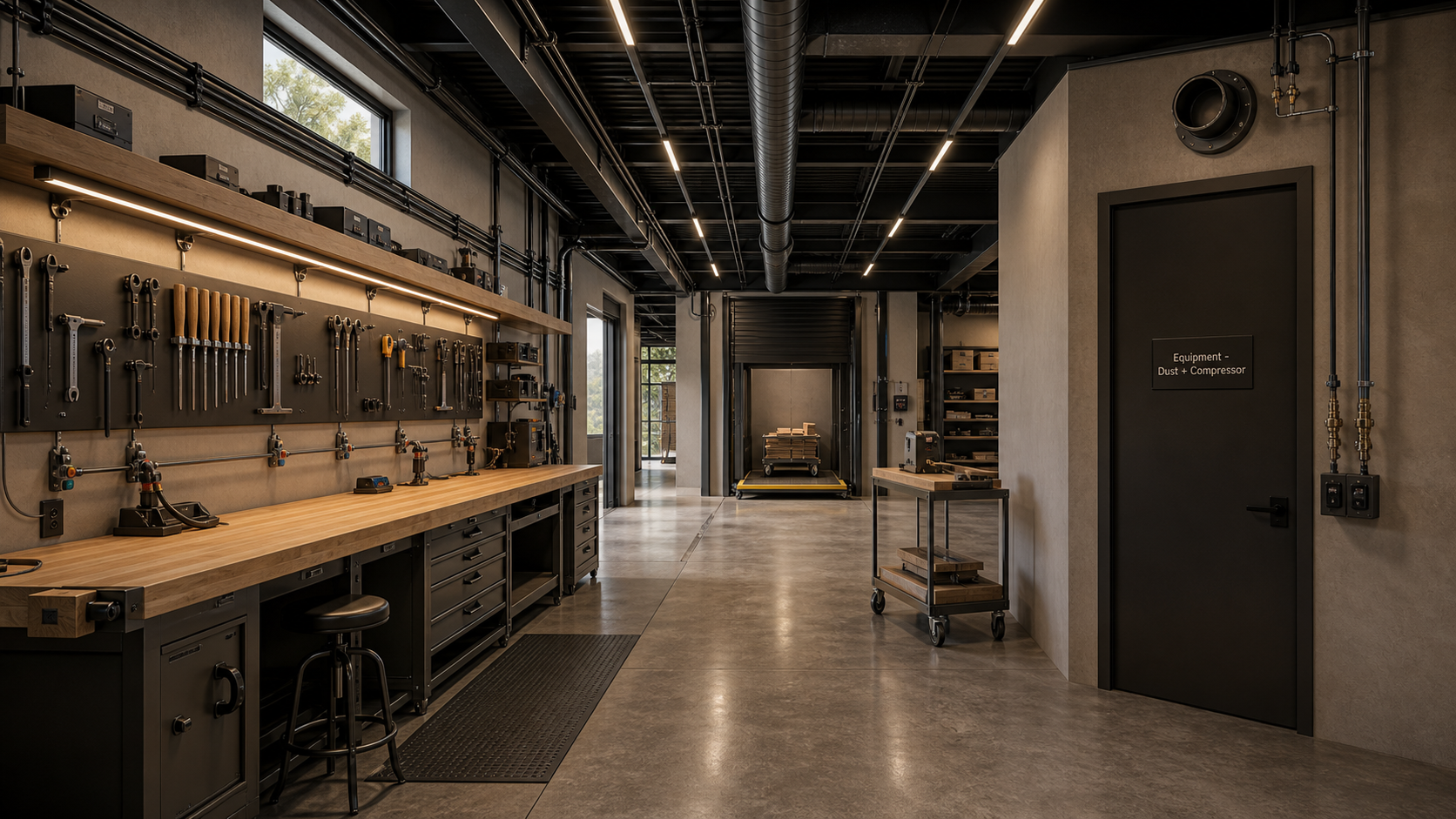
Architectural intent render of LDD-14's "equipment isolated, workflow direct" workshop. For Position Only: AI-generated from the prompt below. Click to enlarge.
Codex prompt & how to regenerate
To regenerate: hand the prompt below to Codex / ChatGPT with image generation enabled (or any gpt-image-1 / DALL-E 3 endpoint), save the result as site/diagrams/14-workshop-fpo.png, redeploy. Page picks it up automatically.
Recommended params: model gpt-image-1, aspect 16:9, size 1536 × 1024.
Prompt:
Architectural interior rendering of the workshop main of a luxury barndominium — a calm, organized work zone with the sealed equipment-room door visible at one side, a clean hardwood workbench along the north wall, and the 7'-wide transport spine running east toward the material lift. Wide-angle photoreal view, ~23'x16' work zone, captured under bright neutral working daylight. 16:9 aspect. No people in frame.

Spatial framing. Eye-level camera (~5'-6") at ~24mm full-frame equivalent, three-quarter view looking from the southwest corner of the workshop toward the east transport spine, so the workbench (north wall) is on the left of the frame, the equipment room door (south wall, west end) is on the right, and the transport spine + lift door beyond is in the distant center.

Equipment room (right side, sealed door — focal architectural detail). A solid sealed acoustic door (gasketed steel-frame, painted matte dark, with a clear room-labeled placard reading "Equipment — Dust + Compressor") set into a medium warm-gray wall that reads visually heavier than the surrounding partitions (double-stud with mineral wool inside, indicated by the wall thickness at the doorway reveal). A dust pass-through port is visible high on the wall above the door — a sealed 6" round metal collar with a short duct connecting through to the workshop side (the pass-through detail must be fire-collared and clean). A compressed-air line and a small electrical conduit also pass through the wall at organized parallel locations near the dust port. The door is closed; faint dust-collector hum is implied by visual stillness.

Workshop workbench (left side, focal work surface). A robust ~12'-long hardwood workbench against the north wall, ~36" deep, ~36" tall, with a warm white-oak laminated top and a dark-bronze steel base frame. Above the workbench: a continuous floating warm white-oak shelf at ~5'-6" height with a recessed linear LED task light beneath it (concealed source, no visible bulb), washing the bench top with bright 90+ CRI 2700K light. Above that, on the wall: a disciplined tool-storage panel in matte dark-bronze metal with hooks for hand tools — organized, restrained, not a chaotic pegboard. Anti-fatigue rubber mat on the floor in front of the bench.

Transport spine (center, leading the eye east). A 7'-wide clear path runs east through the workshop main toward the material lift. Polished light-warm concrete floor with a subtle change-of-surface line (not painted stripes) defining the spine boundary. A wheeled material cart parked at the edge of the spine ready to roll east to the lift.

Pneumatic + dust + electrical discipline (visible at ceiling). Above the workbench: organized parallel runs of dark-finish pneumatic line (aluminum, matte black), dust collection branch duct, and EMT conduit, all aligned to structure, all parallel, all properly strapped to the secondary purlins. Each pneumatic quick-disconnect point along the bench is clean, labeled, and visually orderly. The viewer reads: "every tool drop was designed in advance."

Ceiling. Exposed PEMB structure (primary purlins, secondary framing) in dark charcoal per LDD-12. Round HVAC ducts and linear LED runs aligned N-S. The five-layer hierarchy of LDD-12 is visible.

Material palette. Medium warm-gray walls (durable plywood substrate in the workshop, drywall in the calmer zones), soft charcoal upper infrastructure, dark charcoal exposed PEMB, dark-bronze metal trim and tool panel, warm white-oak workbench top and floating shelf, polished light-warm concrete floor.

Lighting mood. Bright neutral working daylight from a clerestory or high window above the workbench area, supplemented by the task-light glow beneath the floating shelf and the broad linear LED ambient overhead. The room reads bright and crisp — a precision work environment.

What this is NOT (critical). Do NOT render as: a cluttered hobbyist garage workshop, a commercial cabinet shop, a chaotic pegboard wall full of mismatched tools, a designer-magazine empty showpiece workshop, a rusty industrial mechanic's bay, or a sterile fabrication lab. NO yellow safety stripes. NO red toolbox cabinets. NO chrome. NO clutter. NO rusty pegboards. NO visible bare bulbs. NO bright primary colors. NO commercial branding. NO unsupported pipe runs. NO diagonal conduit. NO mismatched tools in disarray.

Style direction. Professional architectural visualization, photoreal, evenly exposed. The render's job is to make a working hardwood shop look architecturally calm and operationally precise — a designed workshop for a discerning maker, not a generic home workshop. Sharp focus throughout, no shallow depth-of-field. Camera neutral. Should feel like the workshop spread of an architecture monograph documenting "a craft space integrated into a residence."
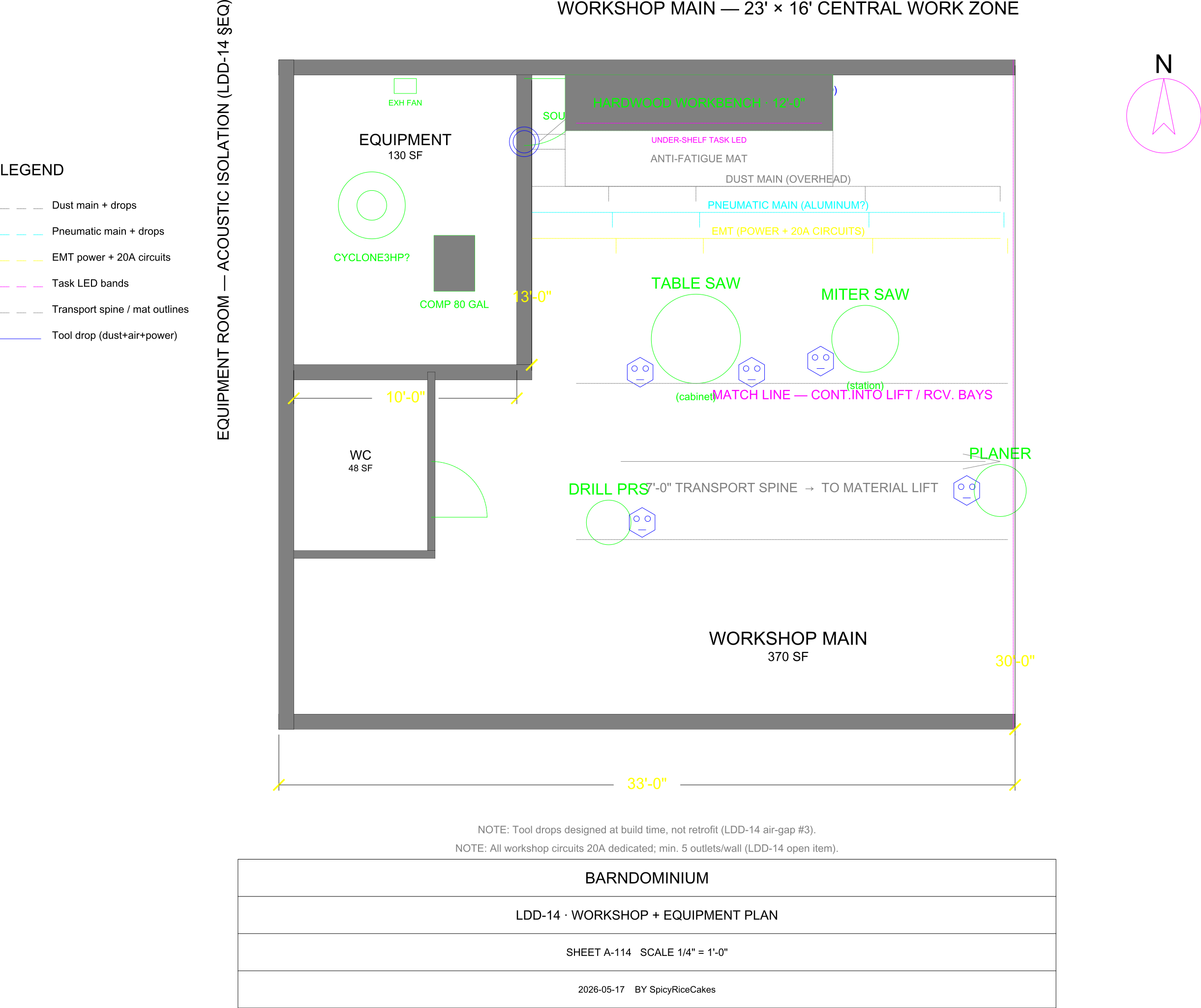
Workshop + equipment room plan · sealed equipment room with dust pass-through · workbench + tool drops · transport spine. Generated plan diagram from the SpicyRiceCakes architecture toolchain. Click to enlarge.
Source Evidence
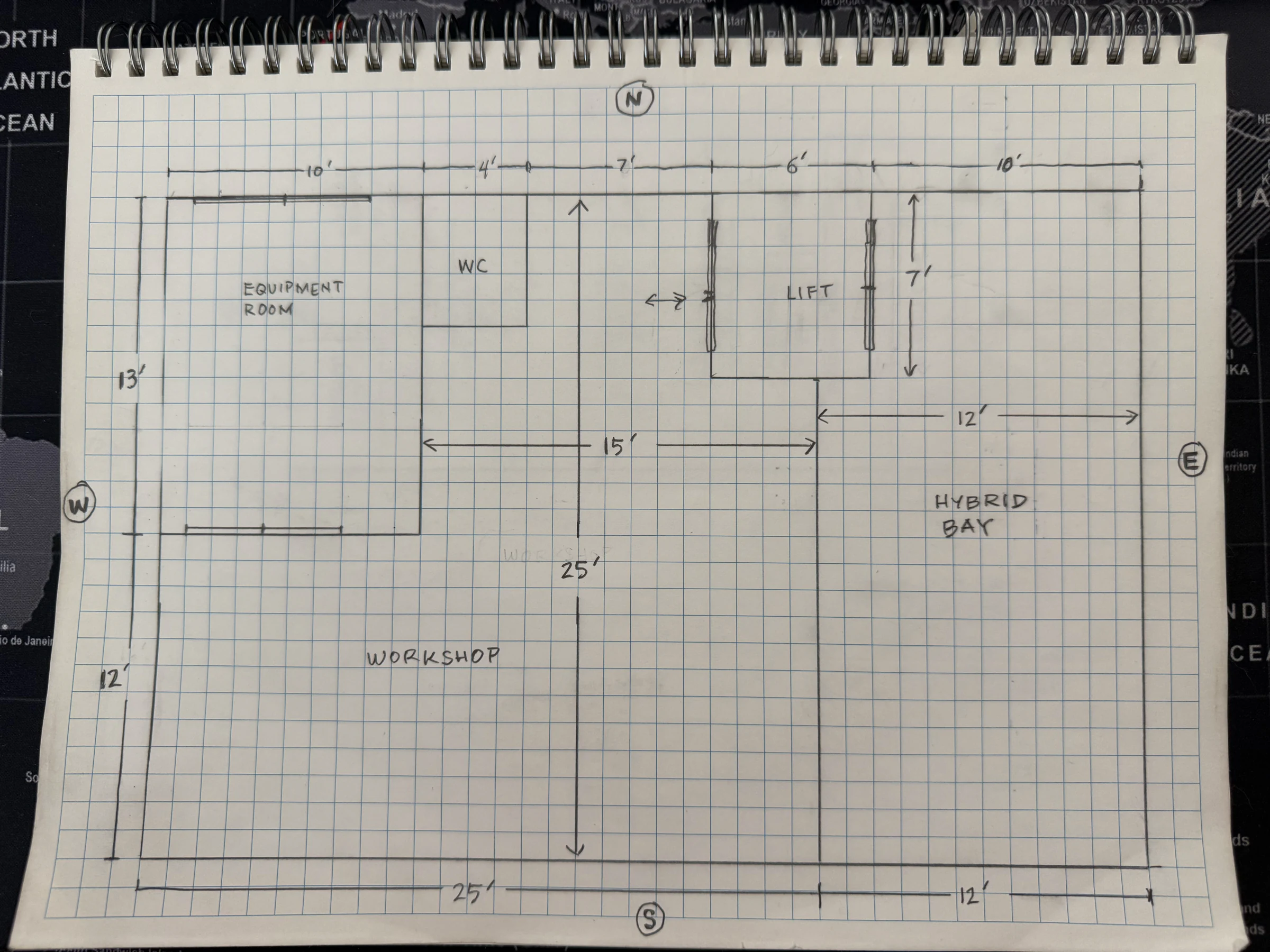
The workshop sketch shows the operational idea behind the generated plan: equipment isolation, workbench zone, and transport spine.