LDD-29 · Gym Architectural Systems
Locked Intent v1.0 Intent is settled and the LDD is bid-ready for most decisions. Promotion to 🟢 LOCKED v1.1 is gated by engineer review of 5 items: hoop spine sizing (§18), clerestory dimensional reconciliation with LDD-04 (§16), destratification fan model selection (§10), urethane gym floor vendor + warranty (§25), and NCAA half-court basketball striping geometry confirmation (§27).
Status: 🟡 LOCKED DESIGN INTENT v1.0 — Peter's 2026-05-17 revised synthesis email (supersedes 2026-05-16 draft, which omitted the gym athletic floor system). Unifies seven focused gym LDDs (04, 08, 12, 22, 25, 26, 27) under a single "calm industrial Great Hall" thesis. Several specs need engineer review before promotion to 🟢 — see Open items.
v1.0 supersede note (2026-05-17): Peter's revised email adds three new sections — §25 Athletic Floor System (radiant slab + rubber underlayment + poured urethane, motivated by lifelong joint comfort and his back), §26 Athletic Floor Finish (matte/satin-matte only), §27 Permanent Athletic Striping Philosophy (NCAA half-court basketball + beach volleyball). Subsequent cards renumbered +3.
Editorial note: Peter's email used cross-ref labels that don't match this set's actual LDD numbering (e.g., he wrote "LDD-15 Lighting" when this set's LDD-15 is the Mechanical Room — actual lighting is LDD-08). Corrected silently throughout this document; full translation table in the Cross-references (Peter's labels mapped to this set) section below.
One-line intent
The gym is a transformable athletic Great Hall — grounded and tactile below the 16' AFF datum, luminous and infrastructural above it — integrated into the home's architectural language rather than functioning as a sports outbuilding.
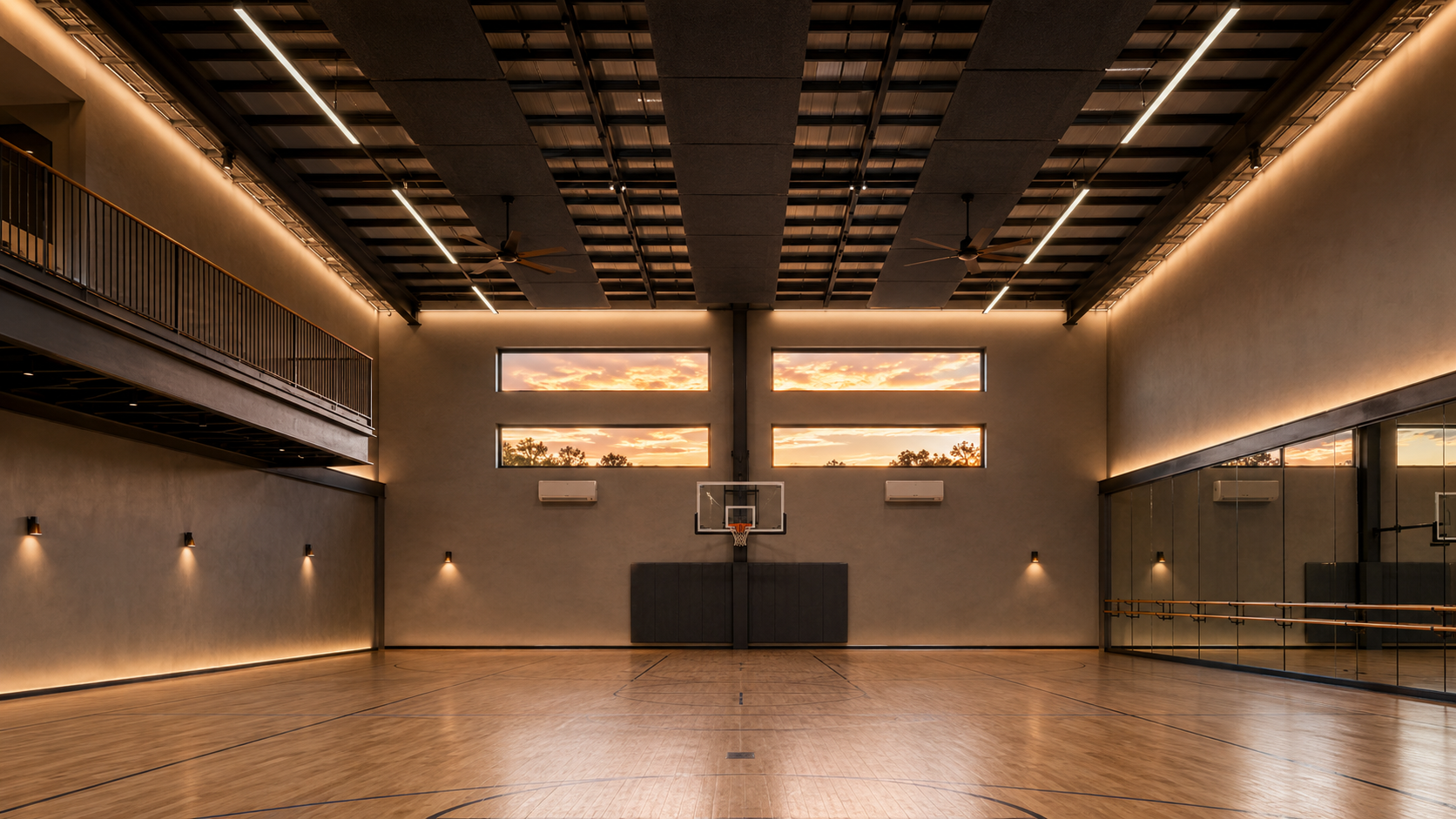
Design intent · AI render
⚠️ STALE render — flagged 2026-05-17. The Codex prompt below has been updated for the new floor spec (matte urethane + NCAA basketball + beach volleyball striping), but this PNG was generated from the OLD prompt and still depicts the hardwood + volleyball-only floor. Priority: HIGH — this is the marquee render for the gym. Hand the prompt below (which is already corrected) to Codex and save the new result as site/diagrams/gym-systems-fpo.png to replace.
Why this matters
The gym already had seven separate LDDs covering its surfaces and subsystems. What was missing was a single doc that says what kind of room this is. Without it, each subsystem gets value-engineered against its own efficiency (cheaper fans, deferred nets, simpler clerestory) instead of against the overall calm-vs-athletic balance. Cumulatively those small choices turn the gym into "warehouse with hoops." LDD-29 is the rule the focused LDDs are tested against during VE.
Locked decisions
1 Core design intent (per §1–2 of Peter's email)
The gym is conceived as a calm industrial Great Hall athletic volume integrating basketball, volleyball, movement, social gathering, atmospheric lighting, acoustic moderation, exposed systems, architectural daylight, air movement, and multigenerational comfort into one unified architectural system.
The gym shall balance: athletic functionality, architectural calm, operational flexibility, visual openness, long-term durability.
The gym shall NOT become: institutional recreation architecture, decorative luxury sports space, boutique wellness architecture, arena-style sports spectacle, generic warehouse gym utility space.
2 Primary spatial hierarchy (§2)
The gym is vertically organized into two primary architectural zones:
| Zone | Approx. height | Character | Contains |
|---|---|---|---|
| Lower Athletic Volume | 0' AFF → ~16' AFF | grounded, durable, calm, tactile, restrained | basketball infrastructure, volleyball activity, movement walls, athletic padding, wall sconces, lower wall systems |
| Upper Luminous Infrastructure Volume | ~16' AFF → roof structure | luminous, infrastructural, layered, open, visually calm | clerestories, acoustic clouds, linear lighting, destratification fans, exposed PEMB, conduit, sprinklers (if required), mechanical infrastructure |
The 16' AFF datum is the gym's single horizontal organizing line — see also LDD-26 transition datum, LDD-04 clerestory bottom.
3 Ceiling organization: three N-S infrastructure bands (§3)
The gym ceiling shall organize around three primary longitudinal N-S infrastructure bands. These bands coordinate acoustic clouds, linear lighting, destratification fans, sprinkler flexibility, exposed structure, conduit, and other overhead systems. The bands are organizational logic only and shall not become decorative striping.
4 Ceiling infrastructure flexibility (§4)
The gym ceiling shall remain sprinkler-flexible — capable of accommodating future sprinkler coordination with minimal disruption to the architectural composition.
5 Primary athletic ceiling lighting (§5)
Primary athletic illumination shall utilize multiple N-S linear LED fixture runs mounted tight to structure, coordinated within the ceiling infrastructure bands. Goals: broad diffused athletic illumination, low glare, economical fixture replacement, high maintainability, layered nighttime dimming. Supports basketball, volleyball, paddle sports, and general recreational athletic use. Prohibited: suspended fragile linear fixtures below the cloud plane.
6 Layered lighting hierarchy (§6)
- Primary athletic ceiling lighting (decision #5)
- Upper perimeter indirect lighting (decision #7)
- Human-scale wall sconces (decision #8)
- Lower indirect perimeter lighting (decision #9)
Modes supported: athletic, social, nighttime atmosphere, lounge, maintenance/service.
7 Upper perimeter indirect lighting (§7)
A concealed indirect linear lighting channel shall occur near the wall/ceiling junction along the primary gym perimeter walls. This luminous datum may visually continue into the UCR, pajama lounge, and overlook edge to reinforce one unified Great Hall volume. Visible LED strips and theatrical cove-light aesthetics are prohibited.
8 Wall sconces (§8)
On north, south, and west walls, aligned at the same height datum. Small-scale, low-profile, restrained industrial forms. Support nighttime atmospheric warmth. Oversized decorative fixtures are prohibited.
9 Low-level indirect lighting (§9)
Subtle low-level indirect perimeter lighting may occur near floor level. Visible LED strip lighting is prohibited.
10 Destratification fans (§10) NEW ENGINEER REVIEW
The gym shall incorporate four destratification fans, equally distributed, symmetrical, coordinated within the ceiling infrastructure bands.
Purpose: reduce heat stratification in the 24' volume, improve comfort, support radiant slab performance, assist mini-split effectiveness, gentle air mixing.
The fans shall: operate primarily at low speed, remain quiet, visually recede into the ceiling zone, coordinate with clouds/lighting/sprinklers/athletics, avoid giant visually dominant warehouse HVLS aesthetics.
Preferred finish: charcoal, black, or dark bronze.
11 Acoustic clouds (§11 — coordinates with LDD-27)
The ceiling shall utilize intermittent longitudinal N-S acoustic cloud groupings organized within the ceiling infrastructure bands, utilizing modular site-fabricated 4'×8' assemblies (per LDD-27). Clouds shall remain visually recessive, preserve visible structure, maintain ceiling openness, function as atmospheric acoustic infrastructure rather than decorative ceiling objects. Continuous blanket ceiling coverage is prohibited.
12 Sprinkler compatibility (§12)
The gym shall be designed as sprinkler-ready. If sprinklers are installed, the system shall remain visually disciplined, exposed, coordinated, and integrated into the overall infrastructural ceiling order.
13 West Hero Wall — core philosophy (§13)
The west wall functions as basketball infrastructure wall, sunset/daylight wall, visual terminus of the Great Hall, and emotional architectural anchor of the gym. It shall read primarily as one calm continuous architectural plane.
14 West Wall center structural spine (§14)
The PEMB center column on the west wall shall remain partially exposed, compositionally centered, and visually integrated. It functions as the hoop centerline datum, clerestory organizer, Great Hall axis marker, and structural anchor. Fake concealment of the column is prohibited.
15 West Wall vertical hierarchy (§15)
- grounded lower athletic wall
- hoop/backboard composition
- lower clerestory band
- intermediate structure/infrastructure zone
- upper clerestory band
- exposed roof/infrastructure zone
The wall shall transition from grounded athletics below to luminous infrastructure above.
16 West Wall clerestories (§16) ENGINEER REVIEW
The west wall shall incorporate four total clerestories organized as two vertically aligned rows, two clerestories per row, symmetrically arranged around the center structural spine.
- Each clerestory: 24" tall × 16' wide
- Function: daylight apertures, sunset glow infrastructure, upper-volume expansion devices
- NOT residential view windows, decorative punched openings, or conventional façade glazing
Frame direction: thermally broken commercial glazing, dark bronze / charcoal preferred, restrained mullion expression.
(Reconciliation with LDD-04 v2.1: LDD-04's "two rows of glazing, 16' module runs subdivided into 4' sub-modules" is compatible — the 4' sub-modules within the 16' runs are a glazing detail. Final mullion layout coordinates with PEMB girt rhythm at glazing order.)
17 West Wall basketball system — hardware (§17)
- commercial-grade adjustable wall-mounted basketball infrastructure
- 72" glass backboard
- breakaway rim
- manual crank adjustment preferred
- upward parked volleyball mode
- dunk-capable hardware
18 Basketball support structure: Hoop Spine System (§18) NEW ENGINEER REVIEW
The basketball system shall utilize a dedicated integrated structural hoop spine system coordinated with the PEMB center structural column, the west hero wall composition, the clerestory hierarchy, and the Great Hall axis.
The hoop system shall NOT rely primarily on IMP panels, light-gauge framing, plywood finish substrate, or non-structural wall assemblies. Primary loads shall transfer into engineered structural steel, PEMB structural infrastructure, and slab/foundation structure where required.
Structural hierarchy (three layers):
| Layer | Function | Carries |
|---|---|---|
| Primary structural | PEMB column + supplemental engineered steel + slab/foundation anchoring | dunk loads, rim loads, impact forces, structural stability |
| Hoop support subframe | Dedicated engineered steel subframe — rectangular tube steel, dark finish, simple orthogonal geometry | adjustable hardware, backboard, parking kinematics, vibration control |
| Architectural wall | West wall finish plane (LDD-04) — visually calm, continuous, architecturally secondary | not a structural support mechanism |
Large exposed triangulated arena-style framing is prohibited unless structurally unavoidable.
Goal projection: rim centerline ~6' projection from finished west wall plane (subject to final engineering + hardware geometry).
Parked volleyball position: upward retracting/parking capability coordinated with volleyball operation. In parked mode the assembly shall remain stable, visually restrained, and clear of meaningful volleyball trajectories.
Vibration performance philosophy: solid feel, reduced perceptible vibration, long-term durability. Minor perceptible energy transfer under aggressive dunk loading is acceptable. The project does NOT require arena-level zero-deflection engineering or excessive structural overbuilding.
Visual philosophy: the hoop system shall visually read as disciplined integrated athletic infrastructure — avoiding oversized exposed steel complexity, decorative sports aesthetics, and over-designed concealment. The hoop shall visually "float" against the calm west wall while remaining clearly supported by real structural logic.
Maintainability: inspectable, maintainable, serviceable, replaceable.
19 West Wall athletic padding (§19)
Standard commercial athletic wall pads, mechanically attached directly to the wall: ~6' tall, mounted ~1' AFF, ~8' total width, centered on hoop axis. Safety equipment, not architectural statements.
20 West Wall finish + acoustic build (§20)
Visually calm, structurally honest, largely continuous. Plywood substrate + mineral wool acoustic moderation + matte medium warm-gray finish + visible but restrained joints. Decorative panel grids behind the hoop are prohibited.
21 West Wall mini-splits (§21)
Two high-wall mini-split indoor units: symmetrical left/right of hoop axis, beneath lower clerestory band, outside primary impact trajectories. Cooling, dehumidification, shoulder-season conditioning. Primary winter comfort remains supported by radiant slab + destratification + envelope.
22 North movement / mirror wall (§22 — coordinates with LDD-25)
Ballet wall, stretching wall, mobility wall, yoga/movement support wall, reflective atmospheric infrastructure. Commercial dance-studio-quality mirrors, safety-backed low-distortion glass, independent rigid backing wall, double ballet barres, acoustic moderation. Full spec in LDD-25.
23 South rebound / acoustic wall (§23 — coordinates with LDD-26)
Adaptive athletic rebound wall, acoustic moderation wall, durable calm athletic infrastructure. Full spec in LDD-26.
24 Acoustic philosophy (§24)
Reverberation moderation, psychological calmness, vocal comfort, layered atmospheric softness — while preserving athletic liveliness, openness, and industrial volume. Avoid harsh warehouse echo, over-deadened acoustic suppression, decorative acoustic aesthetics.
25 Athletic floor system (§25) NEW
The gym floor system shall prioritize lifelong joint comfort, lower-back friendliness, volleyball comfort, dance/movement support, multigenerational usability, acoustic moderation, and long-duration standing comfort — over ultra-hard competitive basketball response, institutional sports aesthetics, or maximum-speed court performance.
Floor build (conceptual):
- radiant slab
- resilient rubber underlayment layer
- poured athletic urethane surface system
- matte low-sheen finish
The floor shall remain resilient, athletically stable, psychologically welcoming, barefoot-friendly, and movement-oriented.
Prohibited: polished concrete athletic surfaces, glossy gymnasium finishes, overly hard institutional flooring, excessively soft foam-like systems.
(Floor build-up and materials cost are carried by LDD-24 Flooring, which already specs poured polyurethane over vulcanized rubber underlayment for the gym zone. LDD-29 §25 adds the architectural intent + body-comfort rationale; LDD-24 carries the spec.)
26 Athletic floor finish (§26) NEW
The athletic floor shall utilize matte or satin-matte finish only. Glossy gym-floor aesthetics are prohibited.
Preferred palette direction:
- medium warm gray primary field
- restrained charcoal-gray athletic geometry
- subtle layered striping hierarchy
Coordinates with material palette decision #34 and LDD-18 Interior Materials.
27 Permanent athletic striping philosophy (§27) NEW
The gym floor shall incorporate official NCAA half-court basketball striping and official beach volleyball court striping, coexisting as a single permanent striping system.
Visual hierarchy:
| Layout | Role | Visual weight |
|---|---|---|
| NCAA half-court basketball | Primary geometry, aligned with Great Hall axis | Slightly more visually dominant |
| Beach volleyball court | Secondary geometry, calm overlay condition | Visually lighter |
Both systems shall:
- remain fully athletically legible
- utilize restrained low-contrast coloration
- avoid bright institutional athletic striping
- support the calm industrial atmosphere of the gym.
Prohibited: large logos, center-court branding, decorative sports graphics.
(Coordinates with volleyball system #28 and floor sleeve covers #29. Striping cost is attributed to LDD-24.)
28 Volleyball system (§28)
Commercial-grade floor sleeve volleyball infrastructure, removable poles and nets, flush athletic floor sleeve covers, equipment-room storage. Volleyball geometry shall remain centered, symmetrical, aligned with primary gym axis.
29 Volleyball floor sleeve covers (§29)
Flush with finished floor, minimize exposed slippery unfinished metal, utilize athletic-friendly coated/textured finishes where practical, minimize visual interruption during basketball use.
30 Pajama lounge / overlook edge railing (§30) NEW
Architectural openness, visual transparency, calm loft-like character. Railing: thin vertical steel rods + dark restrained metal finishes + hardwood top rail. The hardwood rail may utilize harvested site hardwood where feasible. Rustic lodge aesthetics are prohibited.
(Flagged for spinoff as LDD-32 Overlook edge + deployable nets before structural drawings package goes out for bid. Note: previously flagged as LDD-31; bumped to LDD-32 because LDD-30 is now Central Mechanical Core Master Strategy and LDD-31 is reserved for Destratification fans spinoff.)
31 Overlook deployable protection nets (§31) NEW
The underside of the cantilevered overlook edge shall incorporate independently motorized deployable athletic protection nets, concealed within the underside of the balcony structure.
Three deployment zones: left section, center section, right section. The center section shall remain independently operable to preserve open garage-door conditions. Dark neutral mesh, avoid floor-to-ceiling enclosure, intercept only meaningful athletic trajectories.
32 Deployable net philosophy (§32)
Athletic protection nets shall function as targeted impact interception systems rather than full-height containment barriers. Preserve openness, calmness, Great Hall continuity. Institutional divider-curtain aesthetics are prohibited.
(Sister to the LDD-25 mirror-wall deployable net — coordinate motor vendor, control system, housing detail so all gym nets read as one infrastructure family.)
33 Exposed systems philosophy (§33)
The gym shall openly express PEMB structure, lighting, conduit, fans, mini-splits, acoustic clouds, sprinklers (if required), and athletic infrastructure. All coordinated, orderly, visually calm, architecturally integrated. Chaotic exposed utility routing is prohibited.
34 Material + color direction (§34)
Avoid bright athletic colors, glossy institutional finishes, black-box heaviness, decorative sports branding. Approximate palette (final paint/material chips coordinated with LDD-18):
35 Final design intent (§35)
The gym is conceived as a transformable athletic Great Hall integrated into the architecture of the home itself. Balances athletics, atmosphere, daylight, acoustic moderation, exposed systems, industrial clarity, and multigenerational social use — without becoming institutional sports infrastructure, luxury sports theater, or generic recreational space.
Open items / requires engineer review
- Hoop Spine structural sizing (decision #18) — engineered steel subframe + tie to PEMB column + slab anchorage. Structural engineer (Pennoni or Becker Morgan per contractor shortlist). Single largest engineering gap in LDD-29.
- 6' rim projection from west wall (decision #18) — final hardware vendor + retraction kinematics that clear the lower clerestory band when parked up.
- Four-clerestory dimensional reconciliation with LDD-04 (decision #16) — confirm 24"×16' module aligns with PEMB girt rhythm + IMP joint rhythm before glazing order.
- Destratification fan model selection (decision #10) — quiet, low-speed, dark finish. Candidates: Big Ass i6 (charcoal), Hunter Industrial Mariner, MacroAir AirVolution-D. Avoid 12'+ HVLS fans.
- Overlook deployable net design language (decision #31) — coordinate with LDD-25 mirror-wall net so they read as one infrastructure family.
- Overlook railing top-rail wood source (decision #30) — harvested site hardwood feasibility + milling + drying vs. commercial hardwood substitute.
- Urethane gym floor vendor + warranty (decision #25) — confirm vendor at bid (Robbins Pulastic, Mondo, Junckers Connect, or similar pro-grade poured urethane over vulcanized rubber). Verify bonded warranty covers radiant slab thermal cycling and confirm coordination with LDD-24 spec.
- NCAA half-court basketball striping geometry (decision #27) — confirm 28' × 47' college half-court layout, hoop centerline alignment with PEMB column, and coexistence/visual hierarchy testing with beach volleyball striping. Sample mock-up on a 4'×4' urethane test pour before full pour.
- LDD-31 (destratification fans) + LDD-32 (overlook edge + deployable nets) — flagged as spinoffs. Engineering specs deserve their own focused LDDs before structural drawings bid. (Previously slotted as LDD-30/31; bumped because LDD-30 is now Central Mechanical Core Master Strategy.)
Cross-references (Peter's labels mapped to this set)
Peter's 2026-05-17 email (and the prior 2026-05-16 draft) used cross-ref labels that don't match the actual LDD numbering. Mapped here:
| Peter's label | Actual LDD in this set |
|---|---|
| LDD-01 PEMB Structural Shell | LDD-01 Structural — PEMB + spine beam ✓ matches |
| LDD-02 Roof & Floor Systems | LDD-01 (roof + PEMB) + LDD-02 Radiant Slab (slab) |
| LDD-12 Ceiling Infrastructure | LDD-12 Exposed Ceiling Systems ✓ matches conceptually |
| LDD-15 Lighting Systems | LDD-08 Lighting Framework (LDD-15 in this set is the Mechanical Room) |
| LDD-20 Athletic Infrastructure | LDD-22 Basketball Hoop System (LDD-20 in this set is the Primary Social Counter) |
| LDD-27 Acoustic Cloud System | LDD-27 Acoustic Cloud System ✓ matches |
| Living Wing / UCR / Pajama Lounge Design Studies | LDD-06 Living Wing HVAC (closest match; overlook rail + nets not yet in dedicated LDD — flagged for LDD-32 spinoff) |
Cross-references (canonical, this LDD ↔ others)
- → LDD-01 PEMB structural — PEMB center column = hoop centerline datum (decision #14); girt rhythm coordinates with clerestory schedule (decision #16).
- → LDD-04 west gym hero wall — focused LDD; decisions #13–#21 unify around its clerestory + hoop + finish + mini-split spec.
- → LDD-05 HVAC system — destratification fans (decision #10) interact with radiant slab + mini-split performance.
- → LDD-08 lighting framework — four-tier gym hierarchy (decisions #5–#9) specifies the "Gym" scene of LDD-08's project-wide layered system.
- → LDD-12 exposed ceilings — three N-S infrastructure bands (decision #3) refine LDD-12's general rule for the gym specifically.
- → LDD-22 basketball hoop — decision #18 introduces the Hoop Spine structural philosophy refining LDD-22.
- → LDD-24 flooring — gym floor build-up (radiant slab + rubber underlayment + poured urethane) per decision #25; striping spec per decisions #26–#27. Materials + cost carried by LDD-24; architectural intent + body-comfort rationale here.
- → LDD-25 north gym ballet wall — focused LDD; decision #22 unifies. Net design language coordinates with decision #31.
- → LDD-26 south gym rebound wall — focused LDD; decision #23 unifies. 16' AFF transition datum aligns.
- → LDD-27 acoustic clouds — clouds are layer 6 of the gym ceiling per decision #11.
- → LDD-18 interior materials — palette (decision #34) coordinates with project-wide material direction.
Cost drivers
LDD-29 itself adds no line items — it's an organizational intent LDD. The cost impact is the sum of its constituent focused LDDs (04, 08, 12, 22, 25, 26, 27) plus three new gym subsystems not in any prior LDD:
- Destratification fans (decision #10) — 4 fans, quiet residential-commercial hybrid: $1.2–2.5K per fan × 4 = $5–10K including controls + install.
- Overlook deployable protection nets (decision #31) — three motorized zones, concealed housing: $10–22K.
- Overlook railing system (decision #30) — 35'+ thin steel rod balustrade + hardwood top rail: $6–16K depending on hardwood source.
Likely-case rollup for the three NEW gym subsystems: $21–48K on top of the existing LDD-04/08/12/22/25/26/27 budgets.
Athletic floor + striping (§25–§27): ~$16–30K poured urethane + ~$1.5–4K court lines are already attributed to LDD-24 and were in the project waterfall before this revision. LDD-29 §25–§27 add architectural intent + body-comfort rationale, not new dollars.
Air-gap concerns
- The "calm industrial Great Hall" intent must survive value engineering. The hardest pressure on this LDD is the GC's first VE pass — fans get cheaper, nets get deferred, the hoop spine collapses back into the wall, clerestories shrink, the overlook rail becomes vinyl. Each one independently sounds reasonable; cumulatively the gym becomes "warehouse with hoops." Review every gym VE proposal against LDD-29 explicitly — not against the affected sub-LDD in isolation.
- Two new "design study" subsystems (overlook rail + deployable nets) are riding on LDD-29 without their own LDDs. Fine for v1.0 LOCKED INTENT, but those decisions will get challenged at bid time. Recommend spinning out LDD-31 (destratification fans) + LDD-32 (overlook edge + deployable nets) before structural drawings go out for bid.
- Hoop Spine + PEMB center column relationship (decision #18) is a real engineering coordination item. The PEMB column is sized for building structural loads, not for ~2,500 lbf cyclic dunk impact. The "supplemental engineered steel" between the hoop and the PEMB column is the load-decoupling layer. Spec with structural engineer explicitly as a vibration-isolated subframe.
- Four-clerestory dimensional spec (decision #16) must coordinate with LDD-04's "two rows × 24" × 16' modules" exactly. Compatible — 4' sub-modules within the 16' runs are a glazing detail. Final mullion layout coordinates with PEMB girt rhythm at glazing order.
- The destratification fan count (4) needs verification against gym volume. Gym is ~60' × 60' × 24' ≈ 86,400 ft³. Pick smaller quieter fans (4–6' commercial-residential hybrid) rather than 8–24' HVLS.
- Overlook deployable nets and LDD-25 mirror-wall net should share design language. Coordinate motor vendor + control + housing detail.
- "Sprinkler-flexible" (decision #4) is design discipline, not a code waiver. AHJ may require NFPA 13/13R sprinklers regardless. Validate with the New Castle County Department of Land Use at the same time as the Korean BBQ classification question.
- The "exposed center PEMB column" composition (decision #14) competes with the basketball backboard. Decide which is the default composition — column-exposed or backboard-prominent — and confirm the gym's default visual state matches intended use frequency.
- Material palette (decision #34) needs coordination with LDD-18 interior materials against actual paint/material chip selections.
- Floor striping coloration competes with material palette restraint (decisions #27 + #34). Peter's spec is "restrained low-contrast" but the lines must remain "fully athletically legible." Those two priorities pull in opposite directions. Decide the acceptable contrast band at the finishes meeting; spec a 4'×4' urethane sample pour with proposed striping coloration before the full floor pour. Sample also serves as the vendor warranty check (decision #25).
Diagram
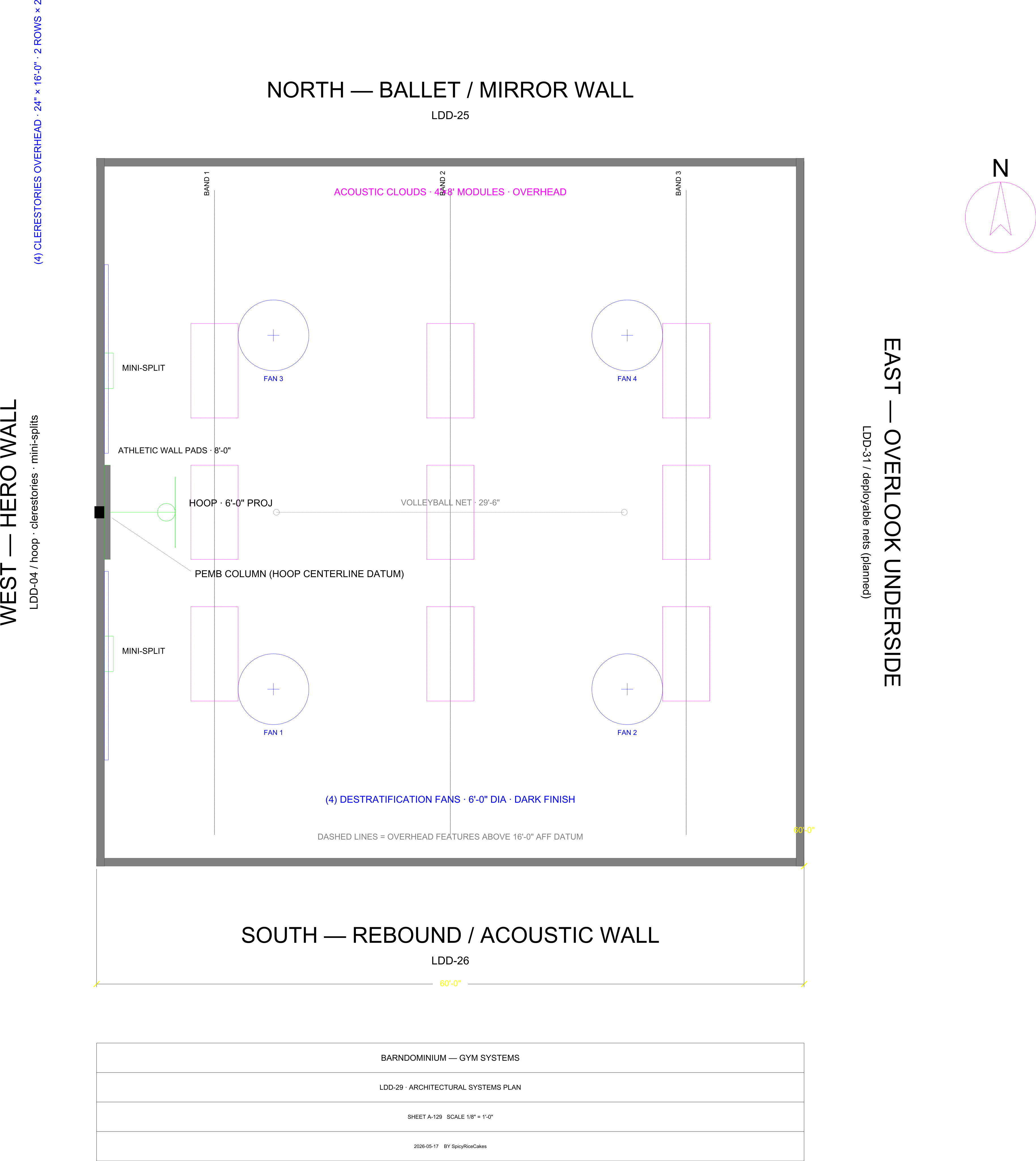
⚠️ STALE diagram — flagged 2026-05-17. This plan SVG was generated from cad/source/gym_plan.py before the floor striping was specified. It does not show the new NCAA half-court basketball striping (primary) nor the beach volleyball court striping (secondary) per §27 above. Priority: MEDIUM — the plan is structurally correct (walls, columns, ceiling bands, fans, mini-splits) but the floor striping overlay is missing. Update cad/source/gym_plan.py to draw both striping systems and re-export to site/diagrams/gym-systems-plan.svg via the shared SpicyRiceCakes architecture toolchain.
Asset Pairing
Status
🟡 Yellow — LOCKED DESIGN INTENT v1.0. Peter's spec is internally coherent and the Great Hall thesis is correct. Promotion to 🟢 LOCKED v1.1 requires:
- Hoop Spine structural sizing with structural engineer (decision #18).
- Four-clerestory dimensional coordination with LDD-04 + PEMB girt rhythm (decision #16).
- Destratification fan model selection (decision #10).
- Urethane gym floor vendor + warranty confirmation (decision #25).
- NCAA half-court basketball striping geometry + beach volleyball coexistence sample (decision #27).
- Spin-out of LDD-31 (Destratification fans) and LDD-32 (Overlook edge + deployable nets). (LDD-30 is now Central Mechanical Core Master Strategy; the gym spinoffs have been bumped accordingly.)
None of these block bidding the focused LDDs (04/08/12/22/25/26/27); they DO block bidding gym ceiling rough-in, west wall structural detailing, and the gym floor pour.